- Album
Come on Feel the Illinoise! by Sufjan Stevens
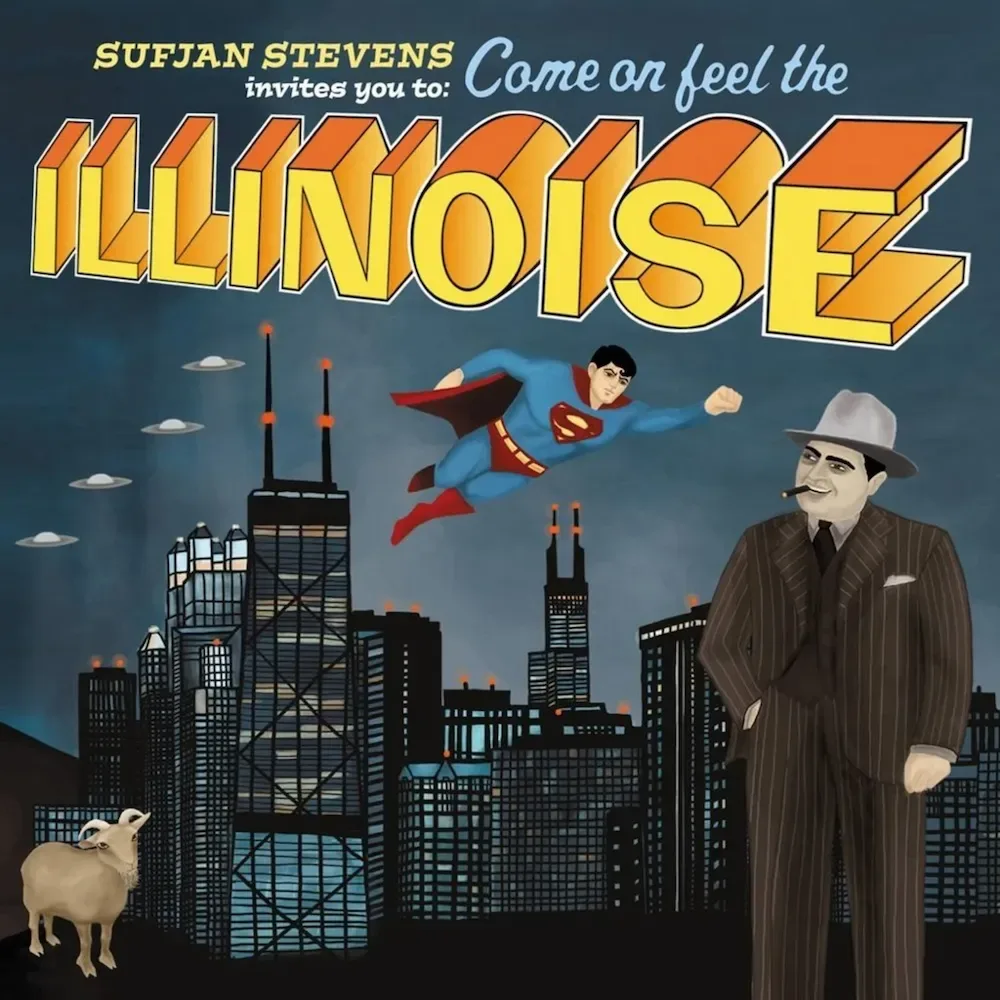
Yes, I was one of those who totally fell for the idea of Sufjan Stevens composing an album for each and every state in the Union. After hearing the ambitious and sweeping scope of his tribute to the Prairie State, with its tales inspired by serial killers, historical figures, young love, and death, I could only imagine what he’d do with the Cornhusker State. (Although Sufjan’s “50 States” project turned out to be a joke, one can’t help wondering what might’ve been.)
Although Stevens has released plenty of gorgeous music after Illinoise, most notably 2015’s harrowing Carrie & Lowell (in which Sufjan wrestles with the death of his mother, who abandoned him when he was just a year old), Illinoise is almost certainly the apotheosis of his indie-chamber-folk. Pulling from Steve Reich’s minimalism, Vince Guaraldi’s playful arrangements, and Nick Drake’s intimate hush, not to mention choral arrangements, marching bands, and even a bit of disco for good measure, there’s nothing remotely subtle about Illinoise. (Even its song titles are bombastic, hence “The Black Hawk War, or, How to Demolish an Entire Civilization and Still Feel Good About Yourself in the Morning, or, We Apologize for the Inconvenience but You’re Going to Have to Leave Now, or, ‘I Have Fought the Big Knives and Will Continue to Fight Them Until They Are Off Our Lands!’.”)
But the wonderful irony is that Sufjan masterfully harnesses his maximalist approach to focus on the deeply intimate and personal. “John Wayne Gacy, Jr.” turns the story of the notorious serial killer into a haunting meditation on sin and depravity, with Sufjan ultimately confessing “And in my best behavior/I am really just like him.” “Chicago” draws on Sufjan’s experiences in the Windy City to sing of redemption while “The Predatory Wasp of the Palisades Is Out to Get Us!” recounts an early gay experience with its heady mix of love, lust, and guilt. But it’s “Casimir Pulaski Day” that serves as the album’s most striking moment, with Sufjan singing of young love, the ravages of cancer, and the struggles of faith and doubt in exquisite and excruciating detail. In other words, it might just be the most heartbreaking song ever written about theodicy.