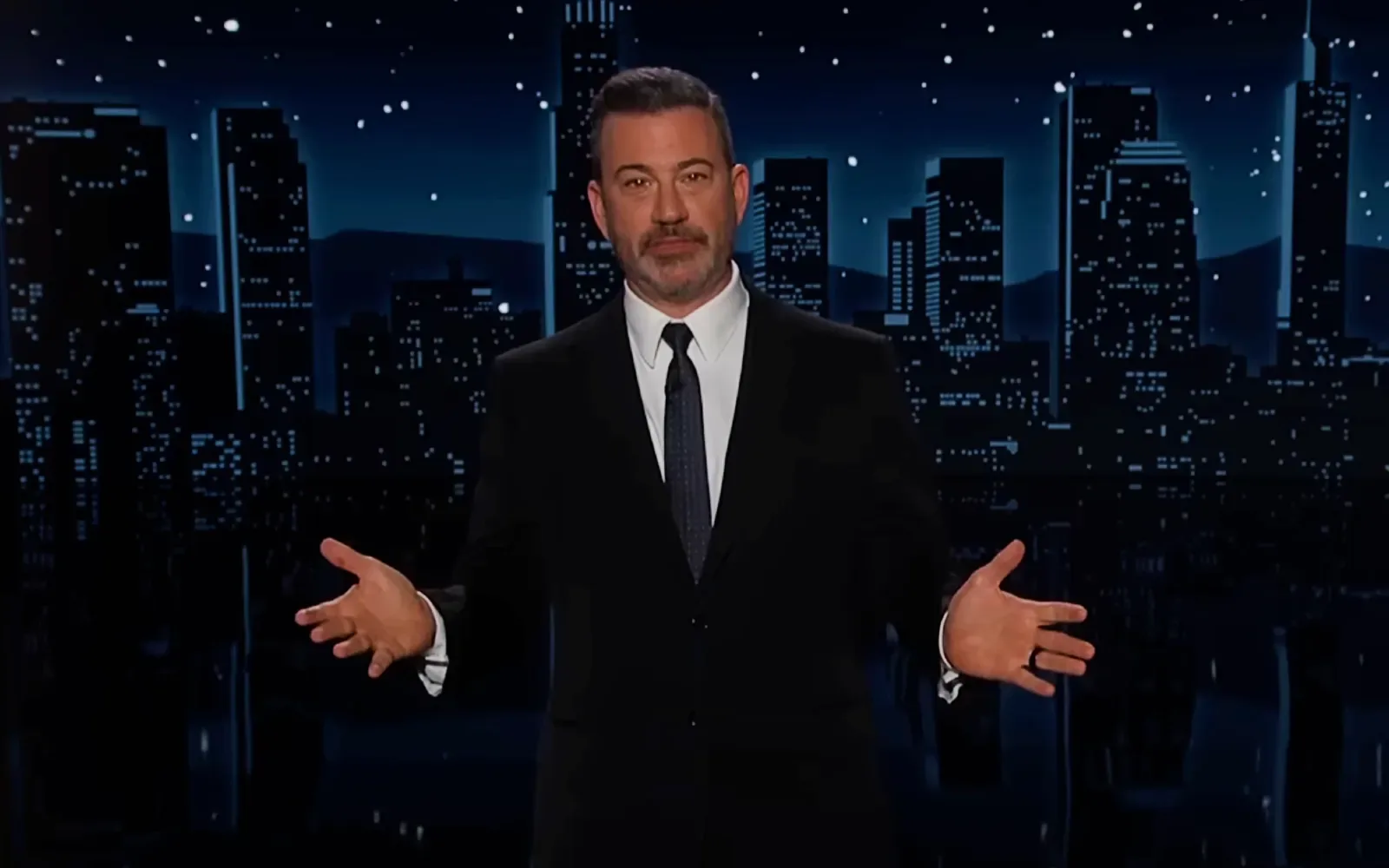
Aside from a few monologues and celebrity roast clips, Jimmy Kimmel has never really been on my radar. At best, I’ve been ambivalent to his career, even going all the way back to Comedy Central’s The Man Show in the early ’00s, and like many Americans, I’ve stopped watching late night TV programming altogether.
Nevertheless, I find Kimmel’s recent cancellation — or indefinite suspension, to use ABC’s terms — alarming, as it should be for anyone who cares about free speech in this country.
During his September 15th monologue, Kimmel spent a few minutes poking fun, not at Charlie Kirk’s horrific death, but rather, at the Right’s efforts to distance themselves from the shooter: “We hit some new lows over the weekend with the MAGA gang desperately trying to characterize this kid who murdered Charlie Kirk as anything other than one of them and doing everything they can to score political points from it.”
That was followed by some jabs at President Donald Trump, FBI director Kash Patel, and congresswoman Marjorie Taylor Greene. In other words, pretty standard late night fare. Kimmel never once belittles Kirk, but at most, engages in some erroneous speculation concerning his killer’s politics and the Right’s reaction. (You can watch Kimmel’s monologue on YouTube; the relevant bit starts at the 2:01 mark.)
In response, FCC chairman Brendan Carr appeared on Benny Johnson’s MAGA podcast and said that Disney, which owns ABC, could face government action unless they did something about Kimmel: “We can do this the easy way or the hard way. These companies can find ways to change conduct and take actions on Kimmel or there’s going to be additional work for the FCC ahead.”
So to clarify, a government official threatened an American company with possible reprisal if they didn’t punish one of their employees for saying something the government didn’t like. To date, it’s unclear what (if any) influence Carr’s statement actually had on ABC’s decision. But that’s really beside the point. Even if Carr’s statement had zero influence on ABC’s decision, and ABC suspended Kimmel entirely of their own volition, it’s still troubling that the FCC chairman effectively declared that the federal government can and will influence such a decision in order to silence someone they don’t like.
If that’s not an abridgment of free speech, then what is?
The FCC regulates broadcast TV by issuing licenses as well as penalties for people who cross the line and say something indecent or obscene on the air. (This is why you can file a complaint with the FCC if you ever see something on TV that you consider offensive.) However, it is not the FCC’s job to determine what is indecent or obscene. It is not the FCC’s job to police free speech. The FCC’s website is very clear on this:
[T]he FCC has long held that “the public interest is best served by permitting free expression of views.” Rather than suppress speech, communications law and policy seeks to encourage responsive “counter-speech” from others. Following this principle ensures that the most diverse and opposing opinions will be expressed, even though some views or expressions may be highly offensive.
An FCC-published PDF titled “The FCC and Freedom of Speech” further outlines what the FCC can and cannot do (emphasis in original).
The FCC is barred by law from trying to prevent the broadcast of any point of view. The Communications Act prohibits the FCC from censoring broadcast material, in most cases, and from making any regulation that would interfere with freedom of speech. Expressions of views that do not involve a “clear and present danger of serious, substantive evil” come under the protection of the Constitution, which guarantees freedom of speech and freedom of the press and prevents suppression of these expressions by the FCC. According to an FCC opinion on this subject, “the public interest is best served by permitting free expression of views.” This principle ensures that the most diverse and opposing opinions will be expressed, even though some may be highly offensive.
The FCC, however, does have enforcement responsibilities in certain limited instances. For example, the Courts have said that indecent material is protected by the First Amendment to the Constitution and cannot be banned entirely. It may be restricted, however, in order to avoid its broadcast when there is a reasonable risk that children may be in the audience. Between 6 A.M. and 10 P.M. (when there is the greatest likelihood that children may be watching,) airing indecent material is prohibited by FCC rules. Broadcasters are required to schedule their programming accordingly or face enforcement action. Similarly, the Commission has stated that profane material is prohibited between 6 A.M. and 10 P.M.
Finally, the courts have ruled that obscene material is not protected by the First Amendment and cannot be broadcast at any time.
Those three categories — indecent, profane, and obscene — are not determined solely by the FCC, but rather, by the Supreme Court via cases like Miller v. California. Furthermore, the FCC clearly explains what constitutes each category:
- Indecent content “portrays sexual or excretory organs or activities in a way that is patently offensive but does not meet the three-prong test for obscenity.”
- Profane content “includes ‘grossly offensive’ language that is considered a public nuisance.”
- Obscene content “must meet a three-pronged test established by the Supreme Court: It must appeal to an average person’s prurient interest; depict or describe sexual conduct in a “patently offensive” way; and, taken as a whole, lack serious literary, artistic, political or scientific value.”
Only obscene content lacks First Amendment protection, and is therefore “prohibited by law at all times of the day.” Indecent and profane content, on the other hand, “are prohibited on broadcast TV and radio between 6 a.m. and 10 p.m., when there is a reasonable risk that children may be in the audience.”
But even if you apply the loosest possible definition of “obscene” to Kimmel’s monologue, that still won’t meet the aforementioned “three-pronged test.” Therefore, it’s protected speech under the First Amendment and the FCC has no jurisdiction over it. And Carr, as the FCC chairman, certainly has no business threatening an American company over it.
Carr also cited “public interest” concerns, claiming the FCC could be justified in going after Disney, ABC, and Kimmel because his monologue represented “an intentional effort to mislead the American people about a very core fundamental fact.” But as the Foundation for Individual Rights and Expression argues:
The FCC has no authority to control what a late night TV host can say, and the First Amendment protects Americans’ right to speculate on current events even if those speculations later turn out to be incorrect. Subjecting broadcasters to regulatory liability when anyone on their network gets something wrong would turn the FCC into an arbiter of truth and cast an intolerable chill over the airwaves.
Furthermore, The Bulwark’s Jonathan V. Last argues that such a notion would hold late night TV comedians to an incredibly high standard of truth-telling:
If you wanted to hold Kimmel to a journalistic, rather than a comedic, standard, then I suppose you could argue that Kimmel misled viewers. By saying that MAGA had been trying to portray the killer as not being a conservative, you might argue that he was leading viewers to infer that the killer was conservative?
I have noticed over the last 72 hours or so a sudden demand that all statements and observations concerning the Kirk murder be factually, incontrovertibly, true.
[…]
Anyone who makes a statement that turns out to be less than fully accurate, or who makes a joke, or who — God forbid — is just asking questions is now liable to have not just a Twitter mob, or their private employer, but the full force of the federal government brought against them.
Indeed, TV comedians are apparently now held to a higher standard than the vice president of the United States:
In the same afternoon that ABC was given the choice of canning Kimmel in either “the easy way” or “the hard way,” Vice President Vance created another story. He said that under Christopher Wray, its former director, the FBI, “should have been investigating the networks that motivated, inspired, and maybe even funded Charlie Kirk’s murder.”
What “networks” that “maybe even funded Charlie Kirk’s murder” is Vance talking about? No evidence — nada — has come to light suggesting the shooter had any accomplices or partners, let alone the backing of a “network.” The evidence released so far suggests the shooter acted by himself.
“You tell me who misled his audience more,” concludes Last. “Jimmy Kimmel the comedian, or JD Vance the vice president.”
So why the kerfuffle over Kimmel’s monologue, which is clearly protected by the First Amendment? Look no further than Donald Trump himself. It’s no secret that Trump has long held a grudge against Kimmel. When Stephen Colbert’s late night program was canceled in July, Trump was over the moon and suggested that Kimmel might be the next one to go. Trump, however, has a bone to pick with all late night hosts.
During a recent press conference on Air Force One, Trump complained about “evening shows,” claiming that “all they do is hit Trump… they’re not allowed to do that.” Which is completely absurd and patently false. Of course comedians are allowed to “hit” the president. The history of late night TV is filled with jokes at presidential expense and they’re all protected by the First Amendment.
Speaking at the Atlantic Festival, late night legend David Letterman reflected on his own history of political humor: “Beating up on these people, rightly or wrongly, accurately or perhaps inaccurately, in the name of comedy — not once were we squeezed by anyone from any governmental agency, let alone the dreaded FCC.” But Trump’s fragile ego can’t handle any sort of ridicule or mockery, and despite all of their jokes about liberal “snowflakes,” neither can MAGA apparently.
Making matters worse, companies now feel compelled to assuage Trump’s ego lest they get on his bad side. Even before ABC suspended Kimmel, one of their biggest affiliates, Nexstar, announced that they were pulling Kimmel’s show from their stations. Nexstar, as it turns out, is trying to complete a multi-billion-dollar merger, a merger for which — surprise! — they need government approval. Similarly, Disney needs to stay on Trump’s good side in order to complete ESPN’s acquisition of the NFL Network. By kowtowing, these companies can guarantee good returns for their shareholders and nice fat bonuses for their executives, and never mind the potential risk to free speech or encouraging Trump’s irresponsible behavior.
Maybe you hate Jimmy Kimmel. Maybe you think his monologue was offensive and you’re tired of him mocking Trump. If so, then more power to you as you freely state your opinion. Just remember: if the First Amendment only protects inoffensive speech or speech that’s approved by those in power, then it’s not even worth the piece of paper it’s printed on. The idea that anyone, regardless of their status or station in life, can freely speak their mind and state their opinion without fear of government punishment or reprisal lies at the very bedrock of our nation and democracy.
It’s more than just a little ironic that all of this is happening less than a year after Trump signed an executive order titled “Restoring Freedom of Speech and Ending Federal Censorship,” which asserts that “[g]overnment censorship of speech is intolerable in a free society” and seeks to “secure the right of the American people to engage in constitutionally protected speech” while ensuring that “no Federal Government officer, employee, or agent engages in or facilitates any conduct that would unconstitutionally abridge the free speech of any American citizen.” Those are fine-sounding words, but if the last few days have proven anything, it’s that Trump’s claim to value and defend free speech was just a farce — a farce that also includes Brendan Carr and the FCC, it seems.
One final thought: Charlie Kirk’s fans and supporters laud him as a champion of free speech who declared his viewpoints with boldness and fearlessly engaged with anyone no matter their opinion. If that’s truly the case, then I suspect Kirk would be horrified by what Donald Trump, Brendan Carr, and the Right are doing, in his name, to our most fundamental freedoms.