Meta’s Removal of My Trump Post Might Not Be Censorship, but It Is Evidence of Something Else
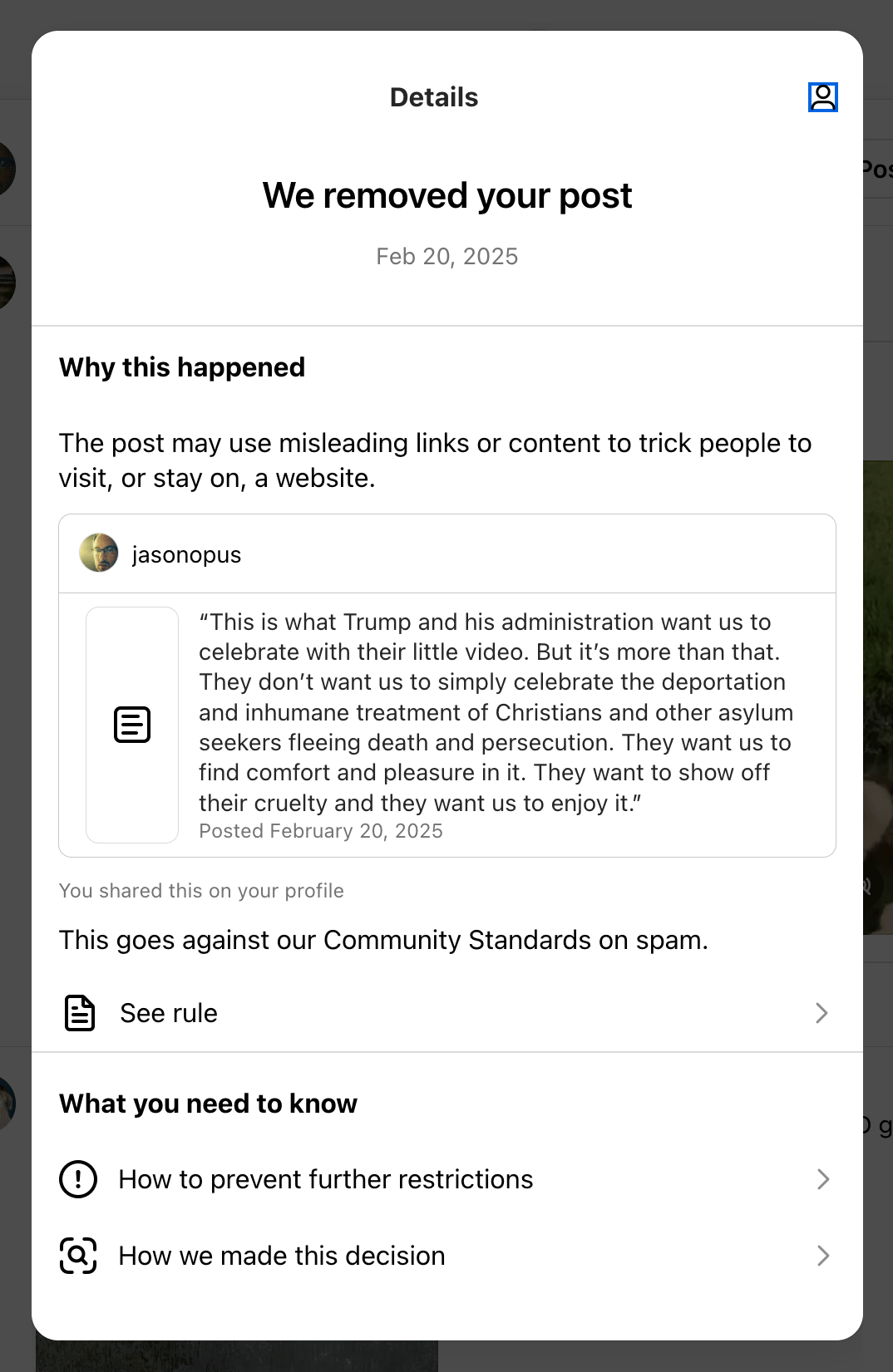
After publishing my post about Trump’s cruelty and the White House’s “ASMR” immigrant video here on Opus yesterday, I shared it on my social media channels, as is my standard operating procedure. These days, that means posting it on Facebook, Threads, and Bluesky. (I’m no longer on X.)
Within a few hours, though, I received notices on Facebook, Threads, and Instagram — all of which are owned and operated by Meta — that my post had been removed for violating their “Community Standards” concerning spam.
So just what, exactly, do Facebook et al. consider spam? According to the pop-up alert that I received, spam can include:
- Telling people they must like a Page to access content on another site
- Using irrelevant pop-ups on websites, to prevent people from leaving easily
- Disguising a link as something on our platform, like a poll or video, to get clicks
The opening paragraph of Meta’s full spam policy offers some additional detail:
We do not allow content that is designed to deceive, mislead, or overwhelm users in order to artificially increase viewership. This content detracts from people’s ability to engage authentically on our platforms and can threaten the security, stability and usability of our services. We also seek to prevent abusive tactics, such as spreading deceptive links to draw unsuspecting users in through misleading functionality or code, or impersonating a trusted domain.
Even a cursory look at my post, however, should make it obvious that what I wrote and shared does not meet any of Meta’s criteria. My post does not use “irrelevant pop-ups,” for example, nor is it disguised to look like something from Meta. I haven’t implemented any “misleading functionality or code” and the post doesn’t impersonate any other site.
Perhaps Meta flagged the post as spam because of volume, since I regularly share Opus links on Facebook and Threads, with most of them going to music and movie reviews — but there’s nothing in Meta’s guidelines that explicitly forbids that. There is a warning that “posting repetitive content” may result in restrictions, but there’s no real definition of what constitutes “repetitive” content. (Does that mean posting the same link over and over again, posting multiple links from the same domain, or something else entirely?)
Adding further confusion, only posts on my personal accounts were removed. That same post is still visible on Opus’ Facebook page. Does that mean Meta applies different moderation standards to content posted on personal accounts vs. content posted on professional/business accounts? And if so, what are the differences?
Since plenty of criticism has been levied at Meta concerning censorship, let me clear: I do not think this is evidence that I am being censored or otherwise targeted. I’ve shared several posts from Opus in recent weeks and months that are critical of Trump and the Right, none of which have been flagged as spam or any other community violation.
I do think, however, that this is evidence of Meta’s incoherent and inconsistent application of their community standards. Which, in its own way, is just as annoying and frustrating as outright censorship. I had a similar experience back in 2021 when my church’s Facebook page was shut down with no real explanation:
For starters, it was impossible to find out why our page had been unpublished other than a vague message that it had violated Facebook’s community standards. Our page, however, contained nothing untoward like misleading information, hate speech, or sexual content. Indeed, according to Facebook’s own “Page Quality” tool, our page had “no restrictions or violations.” Aside from live stream reminders, its content consisted primarily of news about upcoming events mixed with the occasional photo or video from past events like our Easter service.
Eventually, the best I could figure was that somebody had reported our page, but even then, there was no actual evidence of this. I understood why Facebook wouldn’t tell me who reported the page (that would be a major privacy violation), but even just an indication that such a report had been filed would’ve been helpful.
I’ve submitted a request for Meta to review my post’s removal and allow it to be published once again. I’m not holding my breath, though, since Meta’s own stated policies reveal no obvious reason for the post’s removal in the first place.
My best guess is that some combination of words in my post triggered something deep down inside Meta’s secretive algorithms, which then saw fit to flag my post and take it down. But how I’m supposed to counter or protest that, I haven’t a clue.
Taking a step back from my site and my content, and looking at online publishing more broadly, what I’ve described above should only reinforce the importance of owning your own platform — even if you’re just a nerdy pop culture blogger like me. Post anything on Facebook or Threads, and you’re subjecting yourself to their shadowy content moderation processes. (Which, by the way, stand to get even worse as Mark Zuckerberg panders to Trump.)
Social media platforms have usurped the traditional role that blogs and websites have played in sharing content online, with disastrous results for online publishers. If you still rely on services like Facebook and Threads as your primary online platform, you’re doing yourself and your readers a real disservice. The solution? Publish your content on a site that you own, preferably with its own domain, and reinforce to your readers that it’s the canonical source for all of your content. (This is sometimes referred to “POSSE,” or “Publish (on your) Own Site, Syndicate Elsewhere.”)
The need for independent, self-hosted blogs and websites will only grow as social media platforms see increasingly fit to kowtow to a political party that itself is increasingly comfortable with totalitarianism and cracking down on those who don’t play by its rules. Regardless of political persuasion, we should all want to feel confident that those who want to read our content are able to do so free from the undue influence of billionaire gatekeepers. Hosting your own site is a key step to ensuring that comes to pass.