Review Roundup: Kane Parsons’ Backrooms
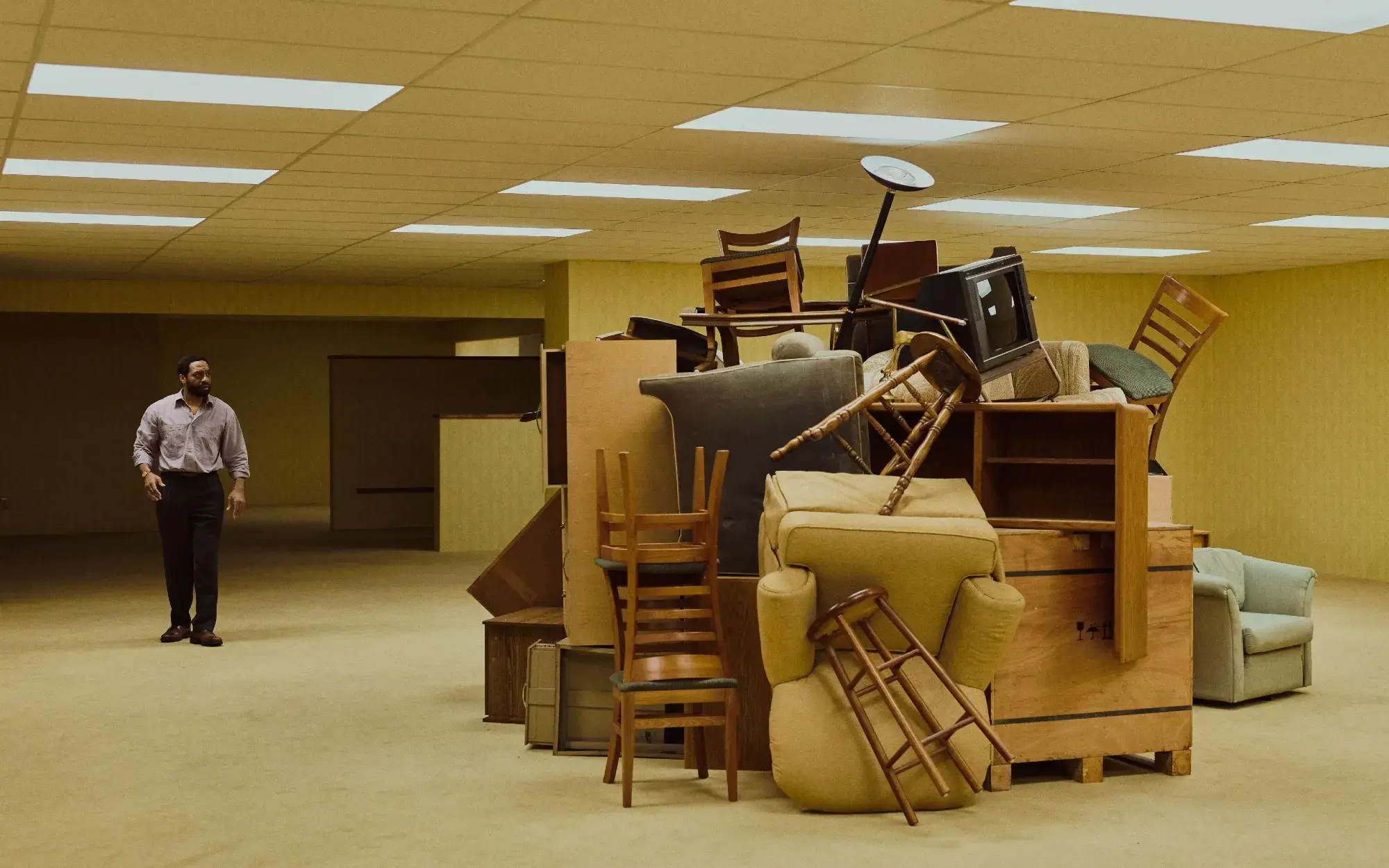
In 2022, amateur filmmaker Kane Parsons uploaded a nine-minute video to YouTube depicting someone “no-clipping” out of reality and landing in the Backrooms, a maze-like complex of flourescent-lit office hallways that proved ominous precisely because of their mundanity. Thanks to its lo-fi VHS aesthetic and embrace of liminal spaces, Parsons’ video went viral, amassing nearly 80 million views since its release. Parsons followed it up with a series of Backrooms-inspired videos, all of which also garnered millions of views, meaning it was only a matter of time before Hollywood came calling.
Four years later, Parsons is directing a feature-length version of his YouTube clip, starring Chiwetel Ejiofor as a furniture store owner and failed architect who discovers an entrance to the Backrooms in his store. The film also stars Renate Reinsve as his therapist, who searches for him when he disappears, as well as Mark Duplass, Finn Bennett, and Lukita Maxwell.
There’s no denying that Parsons’ original short is intriguing; there’s a reason why it so viral, and stuck around after all these years. But does it merit a feature-length Hollywood film? Or should Parsons have just stuck with YouTube? Read on for a selection of critics’ reactions to Backrooms.
Lots of movies have a limited grasp on psychology, that’s not unique to Backrooms, but Parsons’ film revolves around a psychologist and her patient and they talk about psychology all the time, so here it’s more like an albatross. Backrooms has a terrifying aesthetic, but it never assembles a coherent, meaningful narrative. The sad thing is it didn’t need one. If this movie was nothing but a sightseeing tour of disquieting office buildings Parsons probably could have gotten away with it. But the more Backrooms tries to have a point, the more pointless it feels.
The production design of this film, in a word, rocks. The Complex itself is stunning, and feels even more unsettling as a life-sized set, which hardly seems possible when Parsons is so good at building it virtually in Blender. That said, the Blender sequences — and there are several in the film for fans hoping that style would make its way to the big screen — do so much to anchor the movie’s horror foundation in a threat that feels both so far yet so close to our reality. They smartly reinforce the film’s ’90s timeline with a gritty shot-on-video texture that builds a layer of realism before becoming a vehicle to ramp up the horror elements to the max. Paired with smart camera angles and an innate sense of comfortability in crafting compelling images, Parsons shapes a visual language for the world of the Backrooms that feels both homey and horrifying in equal measure.
Parsons and screenwriter Will Soodik tease out a few intriguing ideas about what the backrooms could really be, but that’s all they are. Teases. When tasked with creating something that approaches a cohesive narrative — and a story that confirms tangible internal logic if not necessarily clear-cut explanations for the creepy imagery — Backrooms can only double down on a vague aloofness. The oppressive nature of this seems intentional. The exhaustion and faint tedium less so.
Backrooms offers audiences a suite of bizarre and original horrors well worth experiencing in theaters, and there is no question that Ejiofor and Reinsve bring impressive, authentically human performances to the A24 adaptation. Unfortunately, the film’s traditional character arcs and plot structure work against the sinister meaninglessness and perversion of nostalgia that make its source material so uniquely unsettling. It is a strong film, but a safer one than it needed to be.
It’s not the scariest, or even quite the smartest, horror you’ll see this year… Still, it’s mesmeric and wildly unique in a way I suspect will stand the test of time, since nothing else put to film feels this much like watching the collective Gen Z nightmare come to life — a half-confused grief over never having lived in the analogue era, an attraction to and fear of VHS infomercials, sofa stores, and TV dinner trays.
That Backrooms is so watchable, creepy, and memorable is kind of a miracle. That’s because, when you really break it down, the film doesn’t really have much of a story. Most movies need a good story to be good. However, in Backrooms, it doesn’t matter as much. The world that director Kane Parsons has created and lets us live in for two hours is so endlessly fascinating and terrifying, you’ll never want it to end. And that kind of hook is all you really need.
What makes Backrooms compelling is the way Parsons reverse-engineers meaning into this landscape without reducing the film to trauma-horror cliché. Yes, the maze operates as a metaphor for psychological baggage, grief, depression, and stagnation, but Parsons approaches those ideas with restraint. Monsters aren’t a blunt symbol for repressed trauma. Instead, Backrooms explores the uglier reality of people trapped inside destructive reflexes they cannot escape.
Parsons’ film doesn’t play like an online phenomenon that’s been blown up to the big screen. It’s an intense, disturbing, and disorienting cinematic experience all its own, one that creates a disturbing vibe and then tweaks its frequency to create an unshakeable sense of dread.
It may be smart to streamline the story when there’s so much going on aesthetically, but between the rote characters, barebones plot, and awkward exposition dumps, Backrooms fails to live up to its storytelling potential. A series of intense, claustrophobic chase scenes do make up for this by distracting viewers and keeping them on edge up until the sudden, cryptic ending. But it’s hard to deny that the Backrooms themselves are more interesting [than] what’s happening in them.
The web series sensation of the past few years, Backrooms takes its YouTube stories of endless passageways that lead to echoes of the detritus of our material world, bizarre modern minotaurs, and nods to other spaces of strangeness that manifested in this dark timeline, and fashions an intriguing and disturbing story. Directed by Kane Parsons, and written by Parsons and Will Soodik, it proves that this young wunderkind has a lot more up his sleeve to move from the small to the big screen, and recruits the right talent to lead us all through this maze.
A descent into an uncanny-valley netherworld that’s both a warped reflection and deconstruction of the modern world, 21-year-old Kane Parsons’ debut feature (May 29) is a waking nightmare that prioritizes atmosphere over jump scares, suggestion over explication. While it occasionally weighs itself down with excessive psychologizing, it casts a surrealistic spell that’s unlike anything else in contemporary cinema.
Backrooms is the special kind of horror able to leave an audience shoulders up while they watch a man stomp around an empty space and anticipate what might happen. A manic Ejiofor and a stoic Reinsve give weight to the story, and the craft teams create a mind-bending visual spectacle you can’t look away from. I’m not sure it lived up to the challenge of filling itself out, but it’s nonetheless haunting and beautiful in its disgust.
Backrooms no-clips into theaters on May 29, 2026. Watch the trailer below.
