Days and Deeds by William S. Gray and May Hill Arbuthnot (Review)
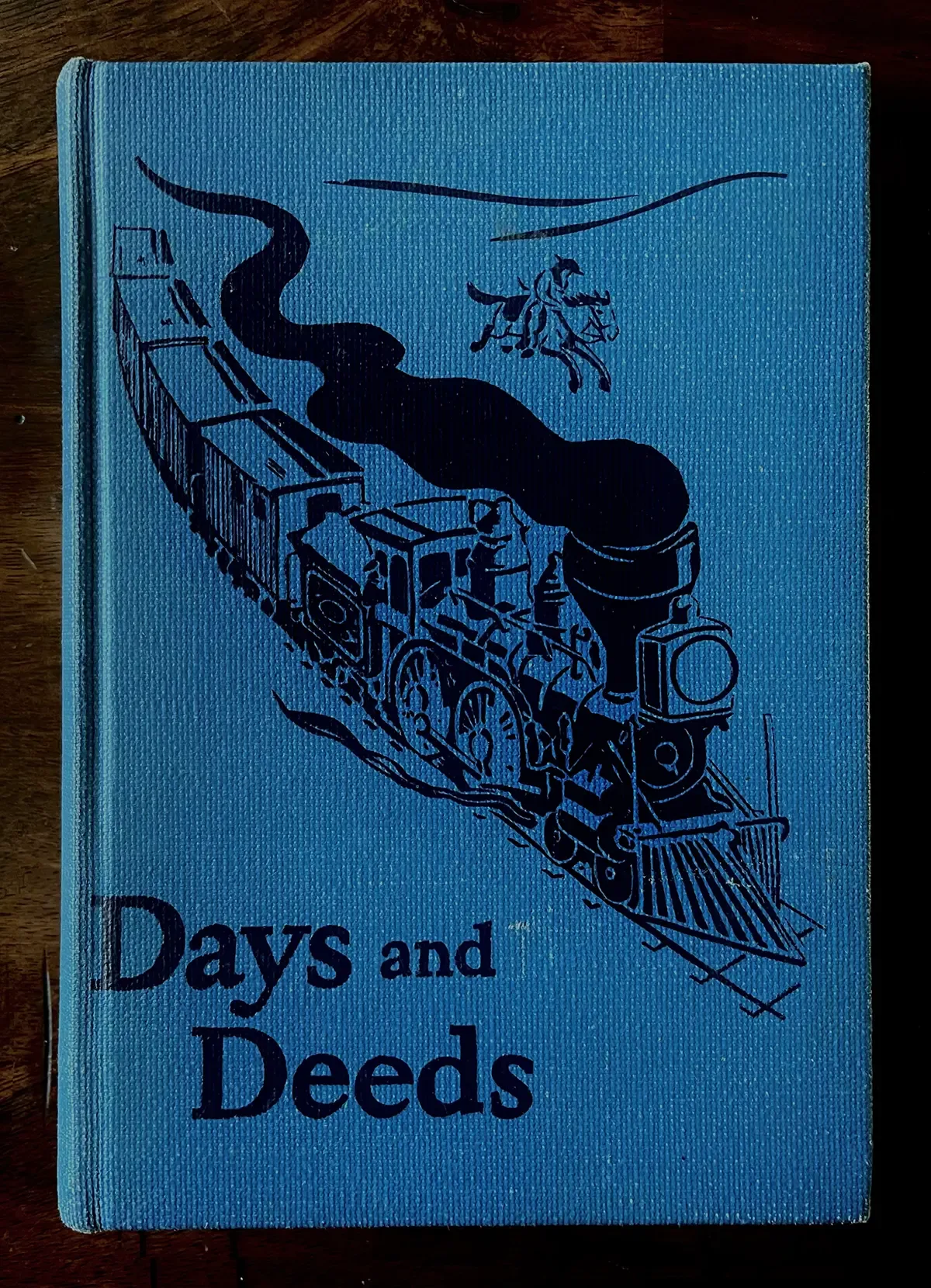
My wife gave me a slew of wonderful gifts for my 50th birthday, and none more so than a copy of William S. Gray and May Hill Arbuthnot’s Days and Deeds. Originally published in 1943 by Scott, Foresman and Company — the same publisher behind the classic Dick and Jane stories — this basic reader was intended to help teach school kids reading and vocabulary through a collection of diverse short stories.
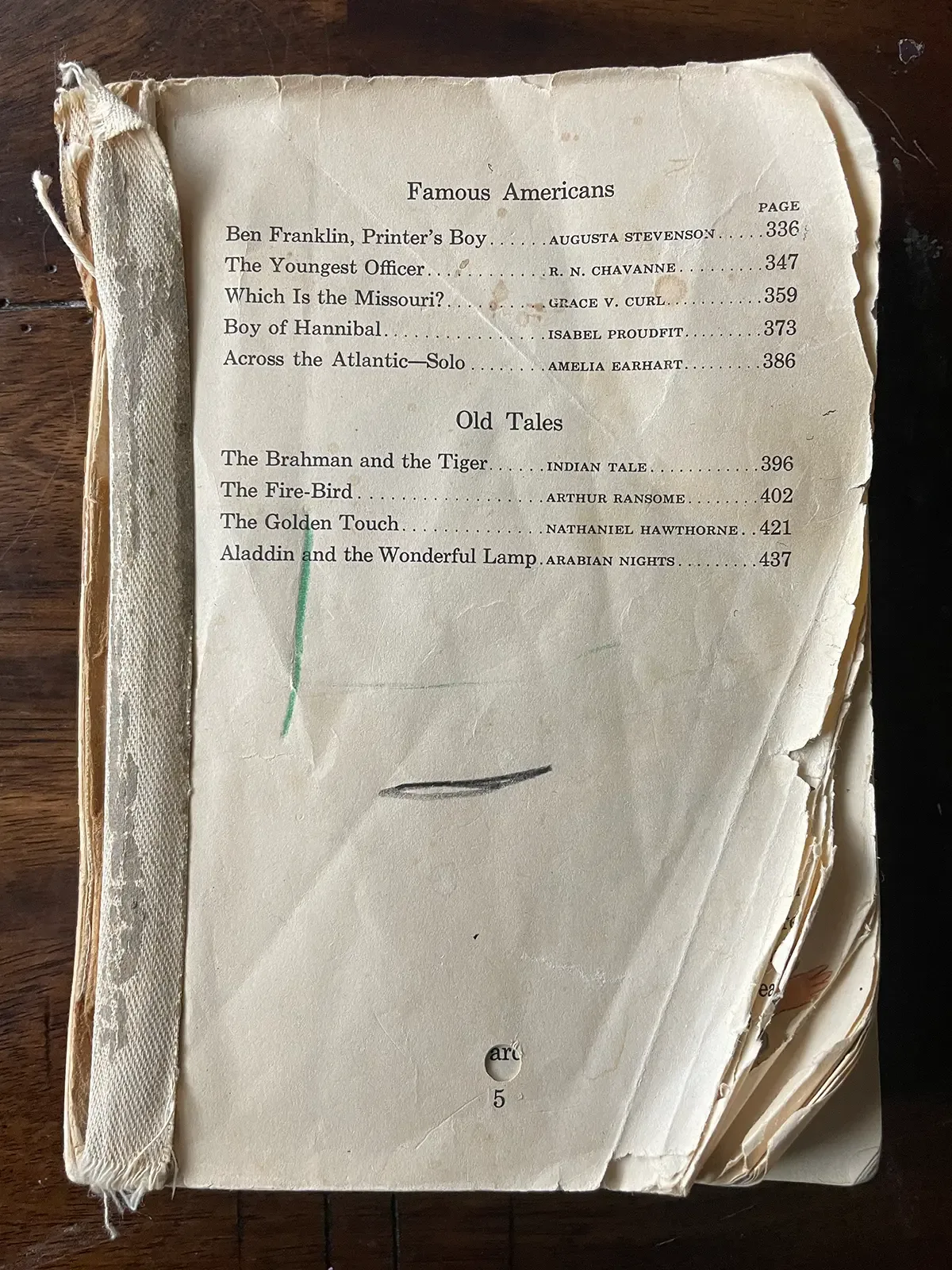
My Grandma Morehead had been a schoolteacher, and I most likely discovered Days and Deeds in her library while visiting one summer. I eventually claimed it for my own, and it soon became a constant fixture in my childhood reading routine. I read my Grandma’s copy so much, in fact, that it now lies in tatters. Thus, it was a real treat to unwrap an intact, near-mint copy of Days and Deeds on my birthday morning.
Divided into sections like “Young Citizens of Today,” “Story-Land of Here and Now,” “Famous Americans,” and “Old Tales,” Days and Deeds contains a wide range of stories. Many are the sort of wholesome fare you’d expect from a ’40s-era childhood reader, filled with cowboys (N. Burglon’s “Red Flame”), pioneers (G. Robinson’s “Rules or No Rules”), and enterprising youths being good neighbors (G. M. Wick’s “The Hurricane”) and hard workers (“Glint of Wings”). In addition to teaching grammar and vocabulary, I wouldn’t be surprised if the book’s editors — William S. Gray and May Hill Arbuthnot — also intended these stories to deliver lessons in civics and good citizenship.
Days and Deeds also features stories about historical figures (e.g., Ben Franklin, Samuel Clemens/Mark Twain, Amelia Earhart) as well as whimsical stories and tall tales featuring P. L. Travers’ Mary Poppins and Dr. Seuss’s stilt-loving king as well as American legends like Paul Bunyan and his blue ox Babe. As a Nebraska kid living smack dab in the middle of the U.S.A., though, my favorite stories were those from other lands.
Some of those stories are based in history, like “A Golden Christmas,” in which young Ingri and the other children in her village outsmart their occupiers to help smuggle Norway’s gold to America. (The occupiers aren’t named, but if you know your history, they’re almost certainly Nazis. Considering when Days and Deeds was published, was “A Golden Christmas” therefore included to support the war effort?) Other stories, like A. Sperry’s “Jambi Wins a Tiger Tooth,” are adventures set in exotic lands like Sumatra. (Given the time period, it’s not too surprising that some stories, like Alden G. Stevens’ “The White Brother,” contain colonialist undertones.)
My absolute favorite stories, though, were the fantastical tales at the book’s end. Perhaps it was because I originally read Days and Deeds while the Cold War was raging and Russia was our greatest enemy, but I was fascinated by “The Fire Bird” and its story of the gallant young archer, his wise horse, and the beautiful Princess Vasilissa. The same goes for the book’s version of Aladdin’s tale from One Thousand and One Nights. This version, however, emphasizes the tale’s Chinese aspects, which was quite new to me at the time.
Making Days and Deeds’ stories all the more delightful are their accompanying illustrations, courtesy of artists like Robert Kuhn, Herbert Rudeen, Harve Stein, and Milo Winter. With their rich colors and vibrant details, many of these illustrations are firmly ensconced in my memory, and helped to bring stories set even in distant lands and times to life.
You might be asking what business a 50-year-old man has reading, much less enjoying, a basic school primer intended for children in the 1940s. I read Days and Deeds for much the same reason that I still read, say, Choose Your Own Adventure books from the ’70s and ’80s. C. S. Lewis said it best: “When I was ten, I read fairy tales in secret and would have been ashamed if I had been found doing so. Now that I am fifty I read them openly. When I became a man I put away childish things, including the fear of childishness and the desire to be very grown up.”
The stories of Ingri, Jambi, the Russian archer, and the rest of Days and Deeds’ myriad characters are timeless for me. They certainly point to a more innocent period in my life, and their idyllic perspective of the world — one in which adventure, pluck, resourcefulness, loyalty, and responsibility always win the day — is still as inspiring and reassuring now as it was back in grade school. Days and Deeds occupies a special place in my library, and I look forward to the day when my grandkids discover it, claim it as their own, and read it until the covers fall off. All books should hope for such an end.