Once Upon a Time in China by Tsui Hark (Review)
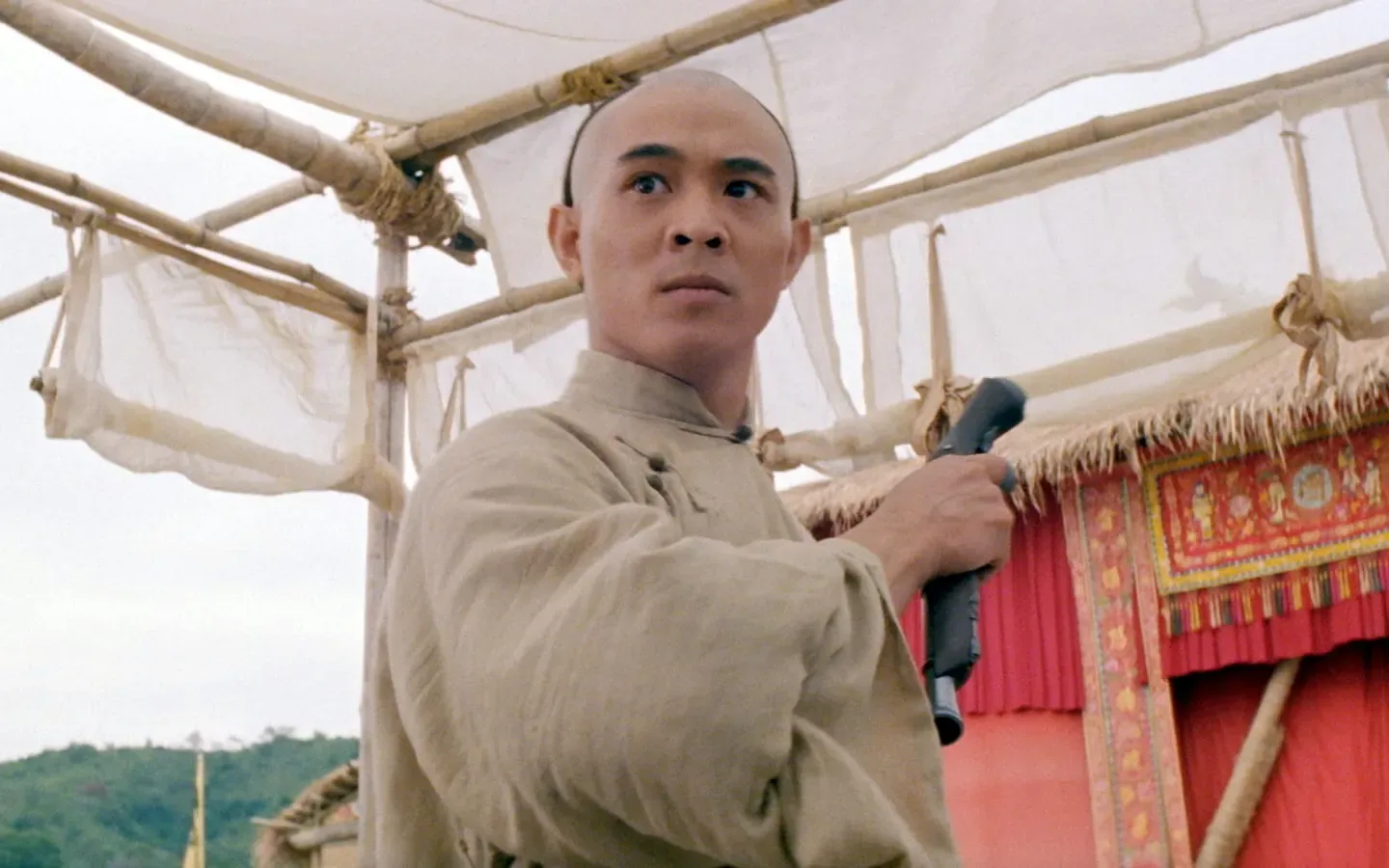
If you were to mention the words “kung fu epic,” I’m sure that most people would look at you rather strangely. But of all of the kung fu movies I’ve watched (and I realize that I’ve barely scratched the genre’s surface), I’d have to say that Once Upon a Time in China comes pretty darn close to being an epic film. It’s got everything you need: a historical backdrop, a strong main character, a little romantic subplot, plenty of action and inner conflict, and a strong message that the filmmakers were trying to convey.
On the surface, Once Upon a Time in China is about Wong Fei-Hung, a Chinese folk hero. Played quite easily by Jet Li, Wong comes across as a stern moral teacher who, more often than not, has his hands full with his troublesome pupils (who are the source of much of the movie’s comedic antics). However, Wong finds that he has three much more serious problems. The first is a local gang that’s terrorizing the local populace. The second is a rival kung fu master who challenges Fei-Hung so that he can become the local master. But the third, and much more insidious danger, are all of the outsiders and foreigners coming into China, especially the British and Americans who are carving up China for themselves.
To say there’s a strong nationalist streak running through Once Upon a Time in China would be an understatement. This movie practically revels in its Chinese-ness. But rather than coming off as xenophobic or jingoistic, you begin to sympathize with the Chinese. Their culture and nation are slowly being carved up, their people lured to foreign lands with the promise of gold and fortune, only to return nearly dead and penniless — if they make it back at all. Wong, being the strong moral man that he is, knows something has to change, but feels completely powerless to do so. He’s afraid of a changing China, but realizes that it’s completely inevitable. Li does an incredible job of conveying this struggle. (Who says kung-fu actors can’t act?!)
But remember, this is ultimately a kung fu movie, and a gorgeous one at that. I must say that this movie contains some of the most beautiful and striking images I’ve ever seen in a movie that boasts this much butt-kicking. In the opening sequence, Wong leads the local militia in morning exercises; watching a hundred men do perfectly executed kung fu against the sunrise and the ocean is sheer visual poetry. Tsui Hark’s use of slow-motion, especially during fights in the middle of a thunderstorm, lends a surreal feel to it all. And his use of shadows and a single candle adds a whole new dimension to the film’s romantic subplot, which involves Wong and his Aunt Yee (who’s not really his aunt), played by Rosamund Kwan.
Okay, so the movie is beautiful to watch. What about the kung fu?! Well, if you’re not a fan of wire-enhanced kung fu mayhem, then you might be a little put off by this one, because there are wires galore. Granted, it doesn’t diminish Li’s grace and power one bit, but some scenes do look a little hokey, especially the final fight between Li and the local kung fu master, which takes place in a warehouse full of ladders. But Li’s natural grace combined with Hark’s camerawork manages to make the hokiest kung fu move a visual delight.
This was the movie that rocketed Jet Li to stardom. He’s second only to Jackie Chan in terms of popularity, and you can see why in this movie. He’s a better actor than a lot of people probably give him credit for. This is probably the most serious role I’ve seen him in, next to Fist of Legend, and he pulls it off quite well. And I’m sure that the film’s strong nationalist tendencies probably filled many of the original audience with more than just a little bit of pride. This movie has a lot going for it, what with Li’s on-screen persona and Hark’s skill behind the camera. Visually striking, combined with a great story and great acting, this is definitely one of the premier kung fu movies, and certainly deserves to be called an “epic” in the genre.
DVD Specs
As far as kung fu DVDs, this one ranks near the top. The picture is pretty good, though a few imperfections pop up now and then. But it really shines in terms of extras, especially the historical section. There, you can find out about the real Wong Fei-Hung and his life, as well as the many movies that have portrayed him. For fun, you can watch clips from various TV shows and movies based on Wong Fei-Hung’s life, including some from the 1950s. Watching these poorly-staged (by today’s comparisons) scenes, you can see how far the genre has come. There are the requisite cast and crew bios, as well as trailers from other movies in the Once Upon a Time in China series, all of which look to be as good as the first.