Princess Mononoke by Hayao Miyazaki (Review)
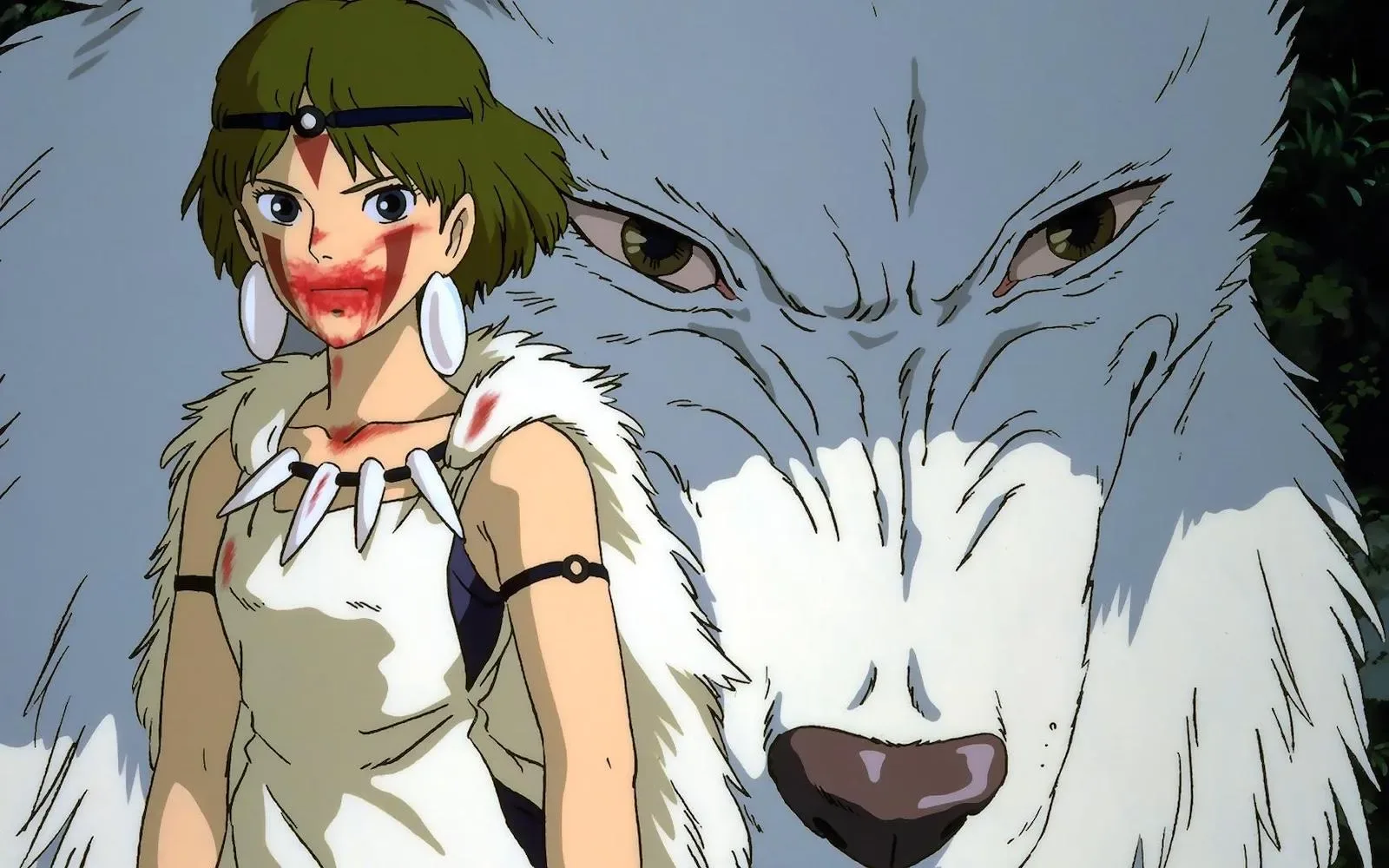
I have waited so long for this time to finally arrive. I had a chance to see Hayao Miyazaki’s Princess Mononoke in the theater when it was released in the U.S. last year. But I really wanted to see the movie with its original dialog, the way it was meant to be (much thanks to Disney for listening to its customers and including the original dialog on the DVD). And it has not disappointed. I’m reminded, now more so than before, of just how remarkable this movie is. It’s been a long time since I’ve seen a movie that has filled me with so much wonder, that has created an imaginary world so lush and inviting that it haunts me for days.
Set roughly in feudal Japan around the 15th century, Princess Mononoke opens with a monster attacking a small mountain village. The village’s young prince, Ashitaka, succeeds in the killing the monster, but not before it wounds him. The monster is revealed to be a giant boar god driven mad with pain and rage. It’s also discovered that Ashitaka’s wound is cursed and will eventually consume him. Ashitaka leaves his village to find a cure, his only clue an iron ball found in the boar’s body. He also discovers that the curse has granted him incredible strength and power, which he attempts to control.
During his travels, Ashitaka meets the monk Jigo, who tells him of the Forest of the Deer God and that he might find a cure there. Heading to the Forest, he rescues some men from a place called Iron Town. Iron Town turns out to be a giant fortress and iron factory. Led by the cunning Lady Eboshi, it has become a powerful and prosperous community, but has also decimated the surrounding countryside. This has angered the animal gods. Led by the wolf clan, and San, a girl raised by the wolves, the animals have begun waging war with man. Ashitaka arrives in the midst of this conflict, and discovers that Eboshi was responsible for the boar god’s death — and his curse.
One night, San attacks Iron Town, intent on killing Eboshi. Ashitaka prevents this, saving San, and leaves Iron Town with her. Wounded during their departure, Ashitaka is healed by the Spirit of the Forest, a deer-like creature who controls life and death. But Jigo and Eboshi want to kill the Spirit. For Eboshi, it’ll mean an end to the attacks of the animal gods. For Jigo, it means vast wealth. Ashitaka and San are forced to trust each other in order to stop the war between humans and animals, knowing that if the Spirit of the Forest is killed, it will mean the destruction of them all.
This brief synopsis doesn’t really do the film justice, because it makes it seem like a simple environmental statement. Although the theme of man and his relationship to nature is dominant, Miyazaki steers clear of any clearcut message. He offers no answers, no happy ending that wraps up all of the loose ends. And he doesn’t shy away from conflict and suffering. The lives of his characters are harsh, and though it takes place in a world of magic, this is no fairy tale.
Miyazaki’s skill as a storyteller is revealed in the humanity of his characters; they can’t be defined in terms of simple good and evil. Eboshi seems like the movie’s villain. But to her people, she’s a noble warrior and ruler. Iron Town is populated by the outcasts of society, including prostitutes and lepers, but Eboshi has given them a chance to have successful, meaningful lives. Ashitaka may be the film’s hero, but he is also naïve about the world around him. The animal gods may be in danger of dying out, but they have become stupid and petty, intent on killing man because they are afraid of him. It is these shades of grey that give Princess Mononoke’s story its depth, and keep it from being heavy-handed and preachy.
If you’ve ever seen one of Miyazaki’s films, then you know that the man is unparalleled in the realm of animation. Princess Mononoke stands as his greatest work. We get it all: vast landscapes, otherworldly forests populated with fantastic creatures, bustling communities, and intricate battles. Miyazaki personally corrected and redrew 80,000 of the film’s 144,000 frames, so we’re seeing his undiluted vision. It’s a real joy to watch this film on DVD (which, I’m convinced, is the only way to view anime). The format’s quality and crispness means the visuals practically leap off the screen. I’ve never seen an animated film this beautiful.
I often found myself as enamored of the little details — drifting smoke and clouds, the tiny movements of animals, the way the wind rustles the trees and grass — as anything else. Looking back on the film, many scenes still remain vivid in my memory: the opening battle between Ashitaka and the enraged boar god; the vast fields and windswept mountains that Ashitaka travels through on his way to Iron Town; San’s rooftop flight through Iron Town as she seeks to kill Lady Eboshi; the Forest of the Spirit walking majestically through the trees at night.
Miyazaki’s films have always been branded as children’s material. Not so with Princess Mononoke. The storyline is probably too confusing, and there is some pretty bloody content, including decapitation and dismemberment. (Though startling, it’s no more gratuitous than, say, Braveheart.) At points, Princess Mononoke gets quite dark. We see much suffering and pain. But we also see moments of great beauty and hope; Miyazaki’s sense of wonder and faith in humanity is still there. It may not be as edgy as anime’s other great works, such as Akira, but Princess Mononoke is a far more rewarding experience. Actually, it’s about as rewarding as cinema gets.
DVD Specs
As I’ve said before, the quality of the animation and the movie is astounding. You’ll never see an animated film this vivid. The original Japanese dialog, with English subtitles is included, as is the dub done for the American release. The dub is actually fairly well done, especially Gillian Anderson as Moro, the head of the wolf clan, and Minnie Driver as Lady Eboshi. But I still have to go with the original Japanese dialog. The only thing that really bothered me about the original dialog was that Moro has a very masculine voice, even though she’s a female. It seems odd compared to Anderson’s voice in the dub (which is perfect), but that’s a minor thing.
As for extras, you don’t get much. You get the trailer, which is readily available on the Web, and a very short “Making Of…” featurette that feels like more of an afterthought than anything else. I’d love to hear some commentary tracks, especially with Miyazaki. The man put a lot into this film, and I’d love to hear his thoughts.
Now that Disney has the rights to many of Miyazaki’s works, I can only hope that they decide to release them all on DVD like this. Despite the lack of extras, this is the only way to watch Miyazaki’s work.