Memories of the Satanic Panic
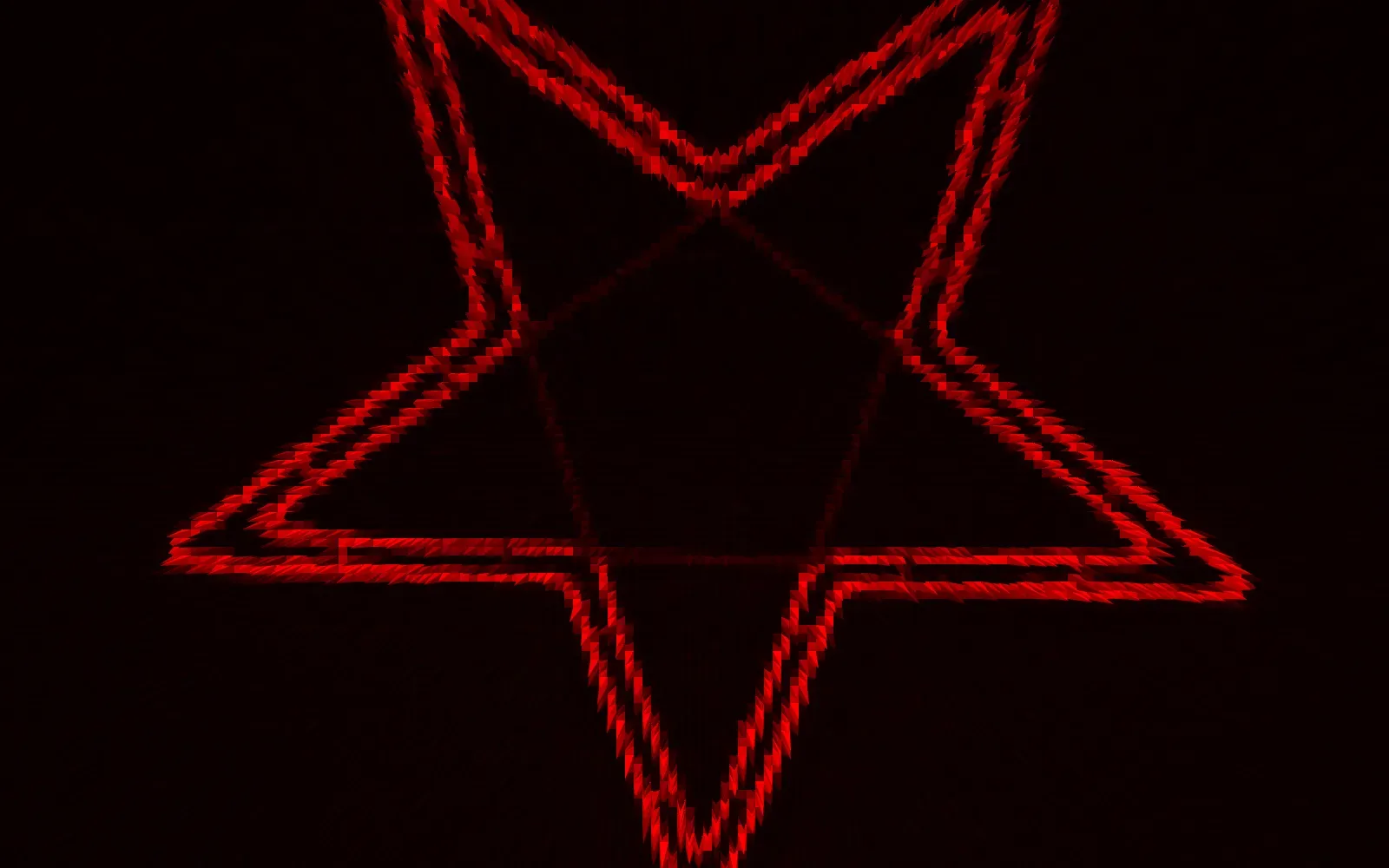
As I wrote in my review of Mike Cosper’s excellent Devil and the Deep Blue Sea podcast, if you weren’t a church kid growing up during the ’80s and ’90s, then I don’t know if I can fully explain what it was like to believe — without question — that an underground Satanic cabal was kidnapping, torturing, and sacrificing children all over the nation. And yet, that fear permeated the culture and the pews for more than a decade.
Looking back on my own experiences with the Panic, though, I was more fortunate than some.
My childhood church was a very typical midwestern, middle-class, non-denominational church. Even it’s name — Evangelical Bible Church — was about as straightforward as it got. EBC was definitely conservative, both politically and theologically, and overwhelmingly white. In other words, it was like a thousand other churches that opened their doors every Sunday morning in America.
I know many have experienced very real trauma in the churches of their youth, but for whatever reason, I was spared that experience. I can’t speak for all of my youth group peers, but my EBC experience was largely positive, even if I no longer subscribe to some of the politics and theology that I was taught. I loved going to youth group, I respected my pastors, and there were some dear adults who poured their lives into mine in various ways.
Even so, the Satanic Panic’s presence could still be felt in EBC’s halls.
Boycotting Procter & Gamble

Thankfully, I don’t remember Pastor Nyquist ever preaching any conspiracy theories from the pulpit. But one day, we brought home a sheet of paper — likely produced on the church mimeograph — that listed all of the products we now needed to boycott because Procter & Gamble’s president had announced on The Phil Donahue Show that he supported the Church of Satan. (I was especially bummed because that meant I could no longer use Crest toothpaste, which I much preferred to Colgate — but we all had our crosses to bear.)
In hindsight, this was patently ridiculous. No such announcement was ever made, nor was the Procter & Gamble logo rife with Satanic imagery. (Its thirteen stars, for example, were a reference to the original thirteen colonies.) Procter & Gamble’s Satanic connections were just a rumor spread, in part, by Amway distributors desperate to boost their sales. And yet, we never once questioned it, because obviously, the president of a massive American company would go on the country’s biggest daytime talkshow to announce that his company’s profits supported the Church of Satan.
How could that not be true?
Here in 2025, it’s easy to look back and ridicule that sort of thinking. But such was the spirit of that age that we never thought to question any purported “evidence” of Satanic influence. We never exercised an ounce of healthy skepticism, but rather, accepted what we were told as fact and changed our lives accordingly. And why wouldn’t we? We were supposed to be vigilant against Satan’s tricks. And nowhere were his tricks more pervasive than the rebellious sounds of rock n’ roll.
Hell’s Bells
I’ve written before about the videos I watched in youth group concerning the evils of rock n’ roll. Rock music certainly espoused some concerning things (e.g., casual misogyny, hedonistic lifestyles). But those videos spent far more time “investigating” occult influences and hidden messages. The obvious concerns, like backmasking and dangerous African tribal rhythms, were just that: too obvious. If you really wanted to get to the root of rock music’s evil, then you needed to analyze the artwork for any cryptic clues.
To be fair, many rock and metal bands did play with Satanic imagery in their artwork and lyrics, though I’d wager that was due more to a juvenile desire for shock value than any true allegiance to the Prince of Darkness (King Diamond and Glen Benton notwithstanding). Much of the videos’ analysis, however, consisted of seeing what you wanted to see.
If you took such-and-such an album cover and held it at a 45-degree angle, then you’d see that white smudge down in the corner was obviously a pentagram. Similarly, if you flipped Dio’s logo upside down, then it obviously spelled the word “devil.” If you flashed the devil’s horns in salute of a particularly awesome song, your fingers obviously formed a 666. The shadowy figure lurking in the corner of Hotel California’s artwork was obviously Church of Satan founder Anton LaVey. Even a band’s name could be a vessel for evil, with KISS standing for “Knights in Satan’s Service” and AC/DC standing for “After Christ, Devil Comes,” obviously.
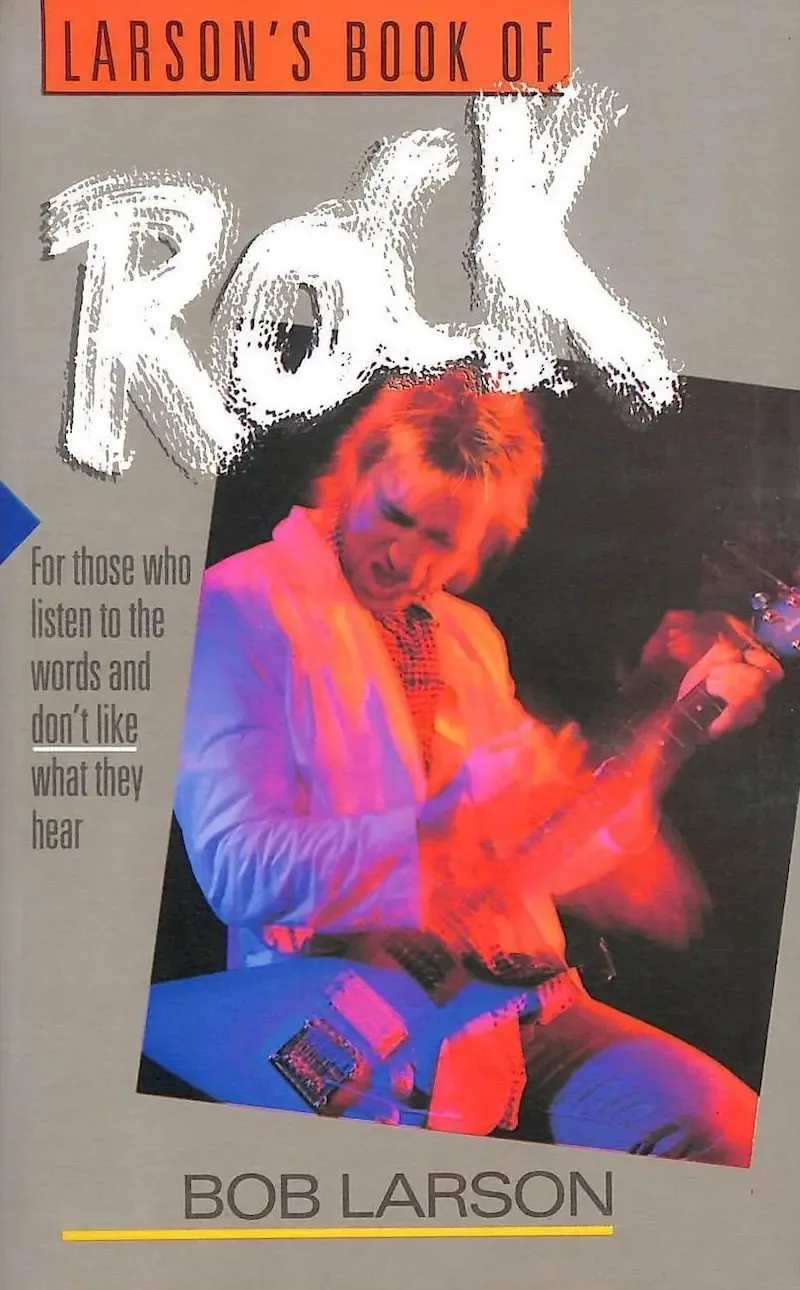
In addition to those videos, which had alarming titles like Hell’s Bells, there was a cottage industry of books devoted to exposing rock’s Satanic influence. Arguably the most popular author of such fare was Bob Larson, a pastor and radio personality who debated Satanists and performed exorcisms on his radio program. In books like Larson’s Book of Rock, he explained, in great and lurid detail, how artists ranging from Black Sabbath, Judas Priest, and KISS to Pat Benatar, John Cougar Mellencamp, and Bruce Springsteen were corrupting America’s youth.
Ironically, Larson’s book had the opposite effect on me that he probably intended. After reading his detailed descriptions of rock star debauchery, I had a strong desire to check out every artist Larson profiled, but not because I wanted to rebel against God and my parents, indulge in debauchery of my own, or was even all that interested in their music. I simply wanted to see for myself whether Black Sabbath, Judas Priest, Pat Benatar, et al. were really as evil as Larson made them out to be.
As with Procter & Gamble, all of this evil — the hidden Satanic imagery, backmasking, and demonic tribal rhythms — was a given, something we just assumed to be true because how could it not be? After all, no less an expert than Geraldo Rivera himself was producing sensational exposés concerning Satanism’s rise in America. Something was clearly happening in our country, and we’d be foolish to ignore it.
The Stories We Told Ourselves
My friends and I did our own part to spread the Panic. Previous generations told ghost stories around the campfire. We scared each other with stories about the unspeakable things Satanists were doing right under our noses.
I have a very distinct memory of a sleepover with a kid from my grandparents’ church, during which we discussed the Satanic coven operating in the area. (Because if Satanists had to pick somewhere to plot America’s ruin, the best place would obviously be in the middle of the Nebraska Sandhills.) Likewise, if a classmate had some news or rumor about a famous athlete or celebrity, my initial reaction was to always assume they’d finally “come out” as a Satanist.
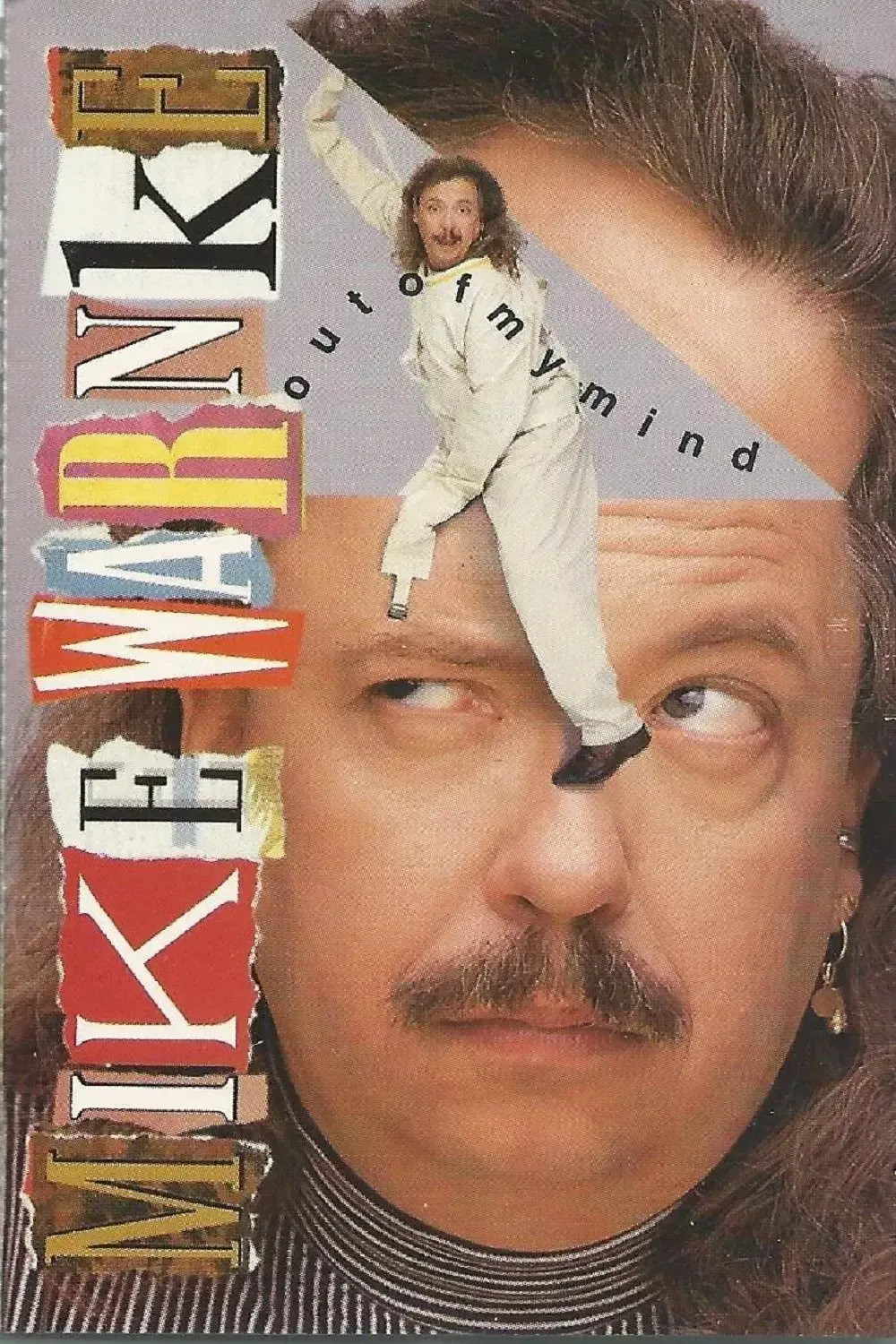
Not surprisingly, the Satanic Panic turned out to be a whole lot of nothing. There was never any real or credible evidence of an underground Satanic network kidnapping and murdering the nation’s children. Instead, there were rumors, hearsay, false accusations, questionable police work, even more questionable psychoanalysis, and plenty of grifting. (Somebody had to make a buck off this stuff, and you’d better believe that Mike Warnke’s comedy albums were a hit in my household.)
However noble people’s intentions might’ve been, the Satanic Panic was just that, a panic that did more harm than good. It ruined the lives of those falsely accused of committing horrific crimes (like the McMartin preschool staff), damaged countless kids who’d been coached into believing that they were the victims of those crimes, and laid the foundation for the social and political division that we see today. Sometimes, I think the Satanic Panic itself was specifically designed by the devil to foment fear and suspicion under the guise of morality and righteous concern.
Nothing’s Not Nothing
Decades later, the Panic’s legacy still manifests itself in various ways. Some of them are fairly trivial and even humorous, like the irrational unease I still feel whenever I see “666,” as if the mere display of those three numbers will result in a demonic curse. (When I was recently filling up my car with gas, I got increasingly antsy as the pump steadily ticked closer and closer to three sixes, and definitely breathed a sigh of relief when it ticked past them.)
Other ways are more nefarious, like its effects on our modern politics. The QAnon conspiracy theory, which gained popularity during Trump’s first presidency with claims that Satanic cannibals were sex trafficking children, was disturbingly familiar. But whereas the Panic’s Satanists had toiled away in secret tunnels under preschools, QAnon’s Satanists could be found lurking amongst the world’s elites. Billionaires, Hollywood celebrities, and of course, the Clintons, were all sacrificing children and harvesting their adrenochrome to create an elixir of youth.
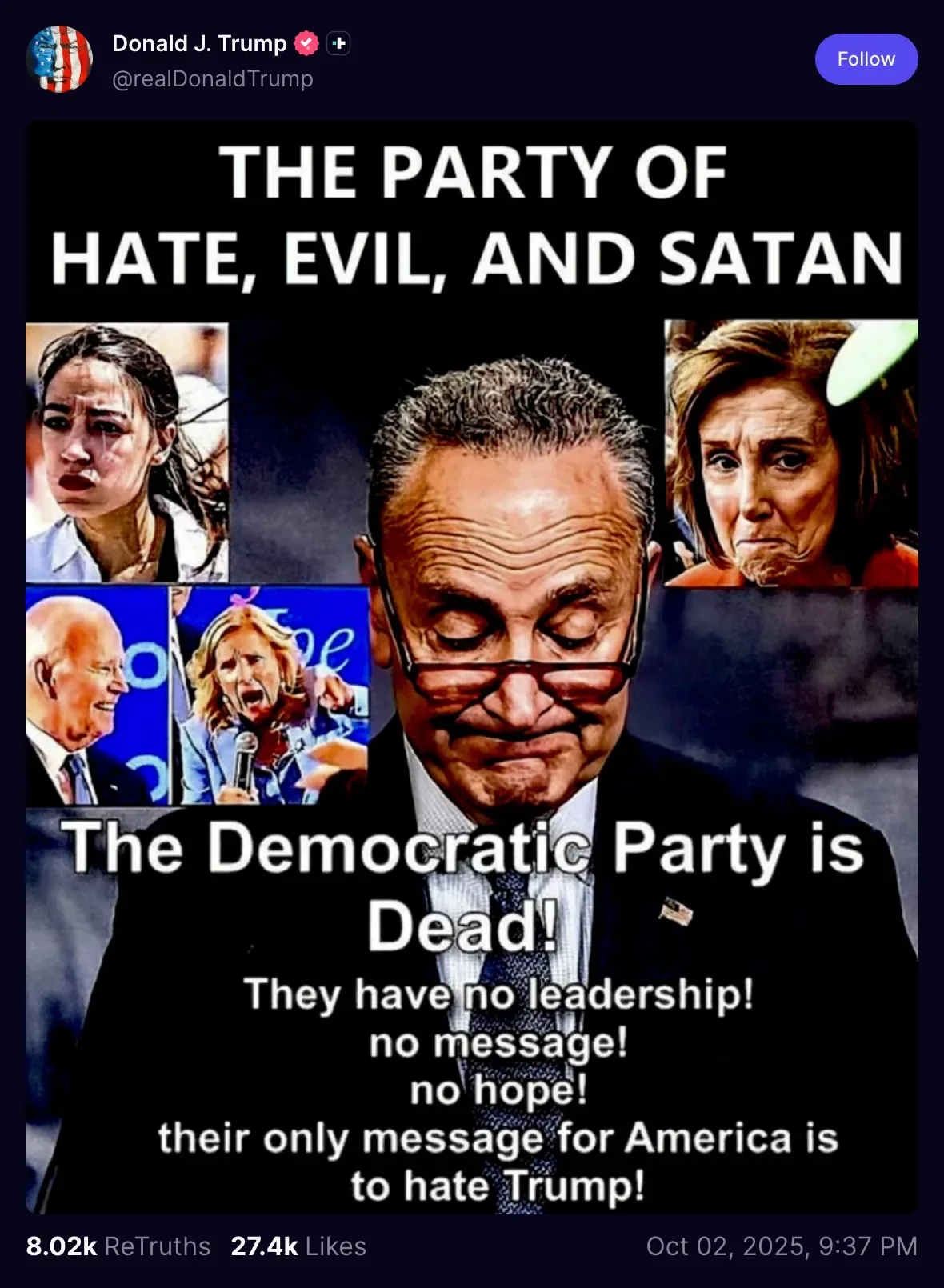
The ease with which Satan is used to criticize our enemies, political or otherwise, also reeks of the Panic’s influence. Even as I was working on this post, Donald Trump — who’s no stranger to utilizing religious imagery — baldly claimed that Democrats are the party of Satan. Which is so far beyond the pale as to almost be comical, until you recall what happened when the Satanic Panic’s adherents whipped the nation into a moral frenzy: false accusations, trials, and many lives ruined. How much more damage could be done, then, by a moral frenzy that’s promoted by the most powerful person in the country, if not the world?
But if this is all so ridiculous, whatever the decade, then why is it so pernicious? Why are we so quick, as Mike Cosper frequently notes in Devil and the Deep Blue Sea, to focus on imagined evils “out there” while turning a blind eye to the very real evils in our midst? Here are two potential reasons.
First, the existence of an external evil, and especially a Satanic evil, enables us to feel like we’re participating in a cosmic battle between good and evil. When viewed through that particular lens, everything becomes so much clearer and more meaningful. We now have the opportunity to become a hero, something that’s very appealing in 21st-century America, which contains so little struggle and discomfort relative to the rest of the world. Casting your vote is no longer just a civic duty; it’s now an opportunity to stand against the very forces of hell. Exercising your convictions is no longer just a matter of personal preference; you’re now engaged in a battle for the nation’s very soul.
Second, an external evil absolves you from needing to worry about your own community. Nobody likes to think that their community — church, neighborhood, family, political party — might contain abusers and other bad actors, because if it does, then what does that say about you? And if you’re forced to confront and confess some rot from within, then not only does that tarnish your reputation, but you also risk losing whatever power and prestige you and your community currently possess. Those are powerful incentives to focus instead on condemning the evil “out there,” even if it doesn’t exist, rather than do the hard and embarrassing work of self-examination and cleaning house. (For evidence of this, look no further than the Southern Baptist Convention’s decades-long history of downplaying sexual abuse.)
All that said, the Satanic Panic’s legacy wasn’t entirely bad. Personally, the Panic, with its many sensational claims that were eventually revealed to be a load of hooey, inculcated within me a healthy sense of skepticism — the very sort of skepticism that I wish we would’ve had when the Panic raised its ugly head in the early ’80s.
Why am I so staunchly anti-Trump? Why am I largely deaf to Republican protestations? Why do cries of “cancel culture” and “Christian persecution” instantly trigger a raised eyebrow? It’s because I detect, in all those things, a whiff of the Satanic Panic’s misguided moral outrage, evidence-less horror stories, simplistic black-and-white thinking, and emotional and spiritual manipulation.
To be told to jump straight to the outrage, as if everything is obvious and undeniable — especially if it confirms your pre-existing suspicions, biases, and affiliations — well, that just puts me right back into the hallways of EBC, and into conversations about Procter & Gamble and Hotel California. For all of the benefits that I gleaned from the church of my youth, I left that particular mindset behind a long time ago, and my life is so much the better for it.
And of course, I’m back to using Crest toothpaste.