It Matters That Donald Trump Doesn’t Know How to Play Uno
If you’ve read any of my political posts in recent years, then you’ve probably seen the term “cultural hermeneutics” pop up now and then. The term “hermeneutics” is often used within the realm of biblical studies, where it refers to the study and method of interpreting and understanding biblical passages. Cultural hermeneutics, as I use the term, therefore refers to the interpretation and understanding of cultural references and artifacts.
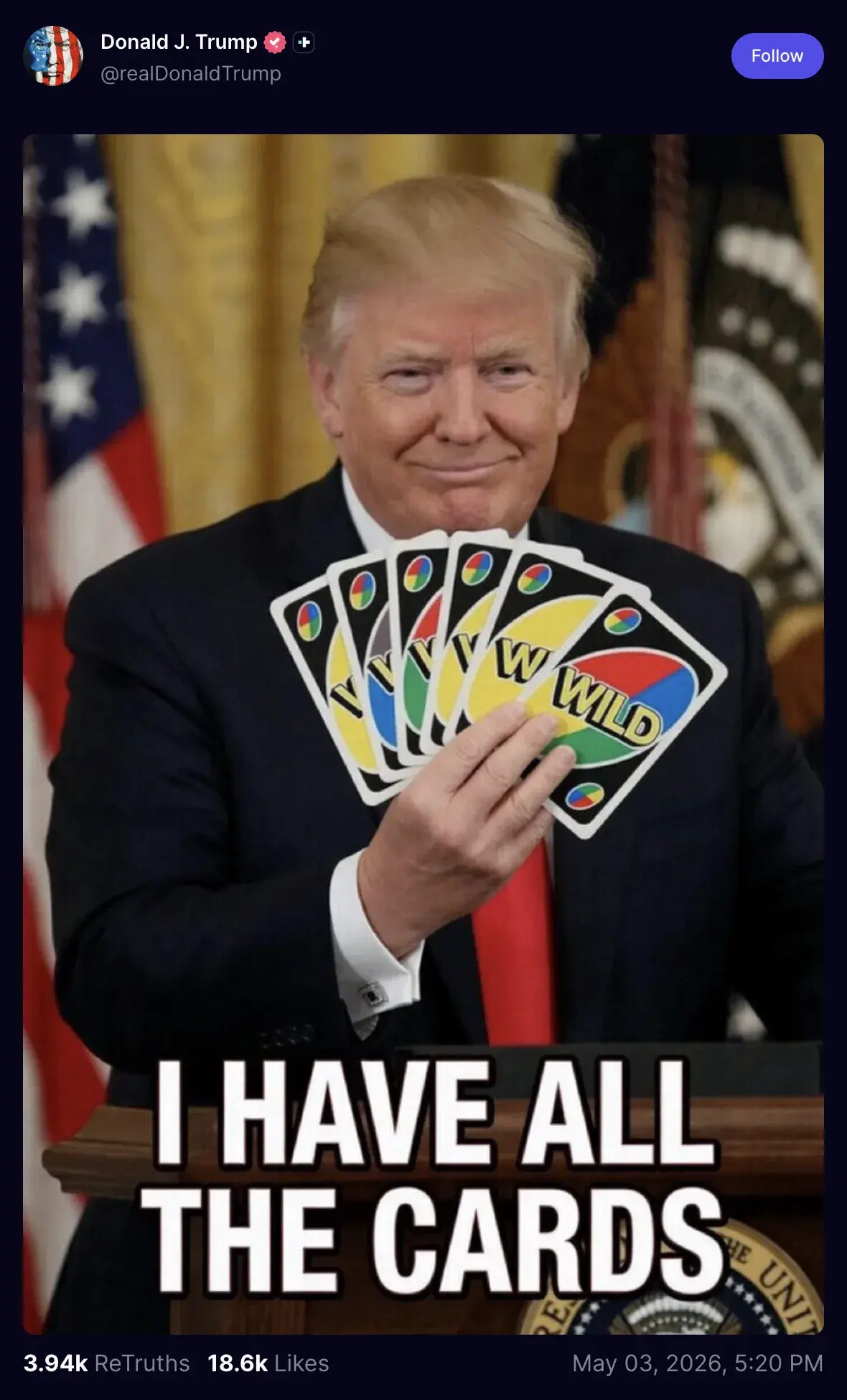
As it turns out, Donald Trump and the rest of the Trumpian Right possess a hilariously poor grasp of cultural hermeneutics. For proof of this, look no further than Trump’s recent Truth Social post that features a badly Photoshopped image of him holding a handful of Uno Wild cards with the caption “I Have All The Cards.”
Based on his other posts around the same time, Trump was probably referring to the ongoing tensions in Iran and the Strait of Hormuz, and his belief that he’s got them under control. Which makes his choice of imagery all the more bizarre. As everyone knows, given the game’s long-standing popularity, the entire point of Uno is to hold as few cards as possible, even Wild cards. Thus, you’d think that someone in Trump’s camp would’ve realized that if the president were playing a real game of Uno with that hand, he would be losing. Which is probably not the message that Trump sought to convey.
When I talk about Trump and his followers having a poor grasp of cultural hermeneutics, this is precisely what I’m talking about: a pop culture reference that doesn’t understand the pop culture that it’s referencing, and as a result, actually undermines its intended message.
Consider Trump’s fondness for Creedence Clearwater Revival’s “Fortunate Son” — a song written to criticize people who used their wealth and privilege to shirk military service, like Trump did with his bone spurs. Or Nancy Mace’s use of the “Cheating CEO” meme to tout Trump’s economic benefits for American workers without apparently considering the real-world pain caused by that display of adultery or Trump’s own long history of infidelity. And then there’s what is arguably the ur-text for Trumpian cultural hermeneutics: a 2020 video of two Trump supporters dancing to Rage Against the Machine’s “Killing In the Name.”

Where to even begin with this? With the woman singing along to lyrics like “You justify those that died/By wearing the badge/They’re the chosen whites” whilst wearing a “Thin Blue Line” flag? Or the guy waving a Trump flag as he dances to a band that proudly (and loudly) identified with leftist politics? The most likely explanation for this odd performance is that the couple simply latched onto the song’s rebellious spirit, as exemplified by Zack de la Rocha screaming “Fuck you, I won’t do what you tell me,” without giving any thought as to what the song actually rebels against (i.e., white supremacy and police brutality).
Thus, we see that Trumpian cultural hermeneutics are ultimately about vibe above all else. If something looks, sounds, or feels like it’s inline with Trump’s image of himself as a tough-talking, swamp-draining, hard-bargaining, lib-owning alpha male, then that’s all that matters, and never mind things like the creator’s stated intent, relevant cultural context, or evidence that Trump is, in fact, none of those things. The goal is maintaining and promulgating Trump’s “strong man” persona, and any other concerns are of secondary importance — if they’re considered at all.
So why does this matter? For starters, pop culture matters. It’s not just disposable fluff and entertainment. Even seemingly insignificant examples of pop culture can speak powerfully to human wants and desires, and what we value and care about as a society and species. Pop culture might not have the same unifying power that it did even just 10 – 15 years ago, but at its best, pop culture can serve as a sort of lingua franca, a common language that transcends usual divides to give us a way to understand and communicate with each other.
Therefore, we ought to give some thought as to how we use pop culture. Obviously, we don’t want to look like fools and frauds. But we should also want to be honest about what a particular pop culture artifact represents, lest we become guilty of simply twisting it to fit our agenda regardless of what might be true. Trump et al.’s use of pop culture is often shockingly crass and callow, displaying no understanding or curiosity, and certainly no concern about any deeper meanings. Like so much of Trump’s activity, it’s just a display of naked power that cares nothing for context, nuance, or truth.
Perhaps Donald Trump really does like “Fortunate Son.” He would not be alone in that; it’s one of the great American rock n’ roll songs for a reason. And I’m a firm believer that people can like what they like for no other reason than because they like it. But Trump goes beyond mere personal preference. He has tried to promote and glorify himself — as he did with last year’s Army parade on his birthday — by using a song that was actually written to criticize and ridicule people like him. And he doesn’t seem to care, not so long as it helps to sell his vibe.
But what about the rest of us? I think we ought to care about such things, at least a little bit. Otherwise, we end up with an “alternative facts”-style approach to art and culture. When I see the Trumpian Right use a pop culture artifact, be it a beloved song or a simple card game, without any care for its actual meaning, I can’t help but think about how Christians in the late ’90s and early ’00s bemoaned post-modernism and what its embrace of relativism meant for things like absolute truth and objectivity. As it turns out, their concerns were not unfounded, but their ire was misplaced.
It wasn’t Hollywood, liberals, or any of the usual conservative Christian boogeymen that perfected a relativistic approach to culture. Rather, it was a man that many American Christians have embraced as their political savior, a man who cares for the truth only to the extent that he can twist and distort it for his own personal gain. With each lie, each “alternative fact,” and yes, each poorly executed pop culture reference, Donald Trump and his followers corrode our culture’s respect for, and valuation of, the truth.