This Is the Week That I Learned Fantasy Author David Eddings Was a Child Abuser

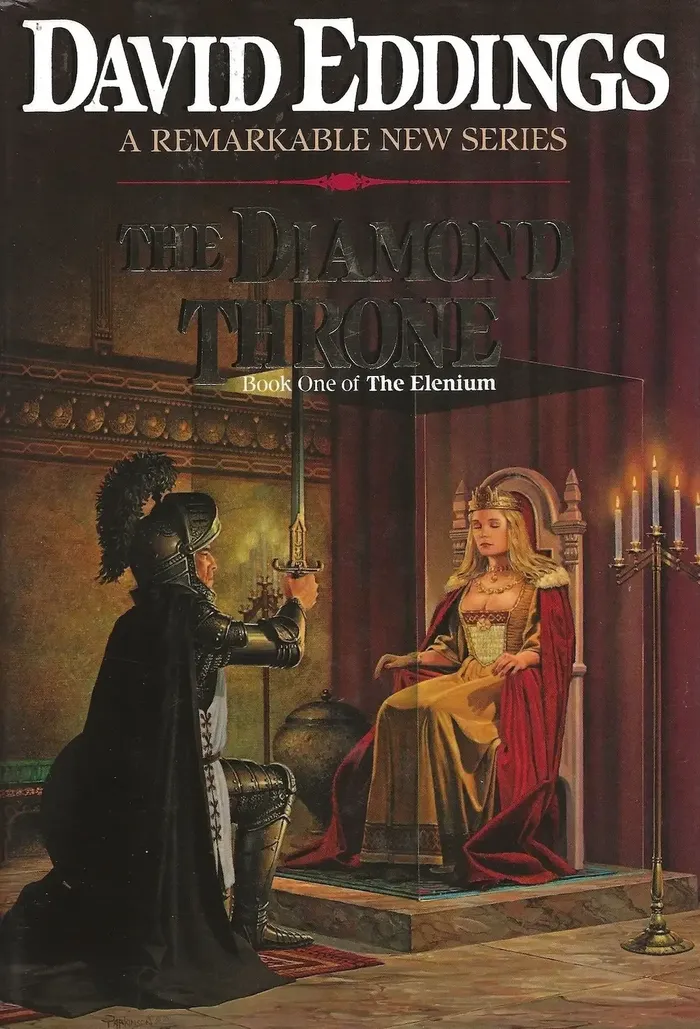
I was in junior high when I saw my first David Eddings book. Specifically, 1989’s The Diamond Throne, the first book in the Elenium trilogy. I recall being fascinated by its cover depicting a knight in black armor kneeling before a beautiful queen encased in crystal. It wasn’t until several years later, though, that I actually bought The Diamond Throne, along with copies of the other Elenium books, The Ruby Knight and The Sapphire Rose. Thus began my Eddings fixation during the mid-to-late ’90s, as I read the Elenium as well as its followup, the Tamuli trilogy.
As is the case with Raymond Feist’s fantasy novels, no one would ever mistake the Elenium and Tamuli for high art. Even so, they were enjoyable enough popcorn reads, filled with heroic knights using swords and spellcraft to battle the machinations of evil gods. Ultimately, though, Eddings’ overpowered heroic fantasy (the novels’ main protagonist, a knight named Sparhawk, is revealed to be the incarnation of a primal force more powerful than all of the gods combined) and preachy dialog (using his characters, Eddings was unafraid to rail against anything he considered small-minded) soured on me, and I got rid of his books. (For the record, I still have several Feist books.)
I hadn’t really thought about David Eddings in years, not until I came across a recent Bluesky thread lamenting certain juvenile tendencies in the fantasy genre. I chimed in with some reminiscences of my own, which is when one of the other participants mentioned Eddings’ history of child abuse. And reader, believe me when I say I was gobsmacked by that particular revelation.
But sure enough, in 1970, when he was a professor at South Dakota’s Black Hills State College, Eddings and his wife Leigh were each sentenced to a year in prison for abusing their adopted four-year-old son. The Eddings’ abuse included locking the boy in a cage in the basement, force-feeding him, and beating him with wet towels. (The Eddings also had a younger adopted daughter, though its unclear from the sources that I’ve found if she was abused as well.)

None of that prevented Eddings from becoming a best-selling fantasy author with 1982’s Pawn of Prophecy, the first book in the Belgariad series. As Wikipedia notes, Eddings was a small-time academic at the time of his trial and conviction; thus, when he and Leigh left South Dakota after prison, news of their abuse didn’t follow them. It was undoubtedly much harder in the ’70s to track down or become aware of such regional news, which helps to explain why Eddings’ abuse didn’t really come to light until after his death in 2009. (Leigh, who co-wrote many of Eddings’ books, died in 2007.) It also explains why there exist glowing obituaries and tributes like this one from Eddings’ alma mater Reed College, which mentions nothing of his crimes as it expounds upon his “extraordinary, life-changing literary legacy.”
Celebrated artists turning out to be bad people is a sadly all-too-common occurrence, one that constantly forces us to ask whether it’s even possible to enjoy art made by such people. Is it possible to completely separate the art from the artist, or is the beauty, goodness, and value that might’ve been found in the art permanently tainted and undone by its creator’s failings? That’s something each one of us must answer, and we may all have very different answers.
Similar to my current views on Neil Gaiman’s work, I don’t know that I’ll ever read anything by Eddings ever again. But can I see someone else coming to a different conclusion? Absolutely. As I’ve written before:
I’m not trying to hem and haw here, but rather, simply acknowledge the reality of human nature. People are complicated, and different people can and will answer these questions differently in different situations, and have perfectly sound and legitimate reasons for doing so.
For example, James Gifford — a humanities professor at Vancouver’s Fairleigh Dickinson University — was a much bigger David Eddings fan than I ever was. As such, I found his own wrestling with Eddings’ crimes fascinating. Gifford continued to read Eddings, only to discover that how he was reading Eddings was deeply changed by his knowledge of the author’s abuse (emphasis mine):
Eddings’ Belgariad novels started in 1982 and earned millions — tens of millions during his fantasy writing career. Those books are also symptomatic. They depict an idyllic childhood, serenely innocent children, a woman like his wife who experiences her happiest moments in life while gently holding a toddler, there’s a direct juxtaposition of his own alter-ego in the books and an abuser, and a failed marriage saved by the birth of a son, and the tremendous gentleness this awakens in his parents. In short, I now read Eddings’ later fantasy novels as an impossible attempt at atonement, a desperately failed wish put to paper, and a tortuously painful digging out of his and his wife’s shame. As a modernist scholar, this changes nothing about how I interpret the books or recognize their extensive allusions to literary texts or pro-labour politics. It is a change of affect not interpretation.
Author Ben Peek, who grew up reading Eddings’ books, had a similar experience (again, emphasis mine):
I’m interested in just how much the work of The Eddings was a confessional one, and one that once you know about their conviction, turns it partly into an exploration their guilt, and their desire to find a redemptive arc for themselves. There’s no excuse or justification for what The Eddings did. In 1970 they were charged with child abuse and went to jail. It is what it is, but like Perry, the Eddings’ served their time and that serving seems to have changed them. David Eddings began writing again while in jail, and though the fantasy novels weren’t published until well after he’d been released, there is a direct correlation to their conviction and the writing that came later. You can even argue that within the work there is an apology and an element of wish fulfilment. Their fantasy books are full of characters who overcome their flaws, create large, sprawling found families, and allow all but the most reprehensible to find not just forgiveness, but a new life as well.
Were Eddings’ fantasy novels an attempt at apology and atonement? Obviously, we can’t ask him or Leigh about that; they’ve both been dead for almost two decades now, and Eddings rarely granted interviews to begin with. And if that was the case, would it be enough? Could Eddings have written his way out of guilt and shame?
For many, the answer to that is a resounding “No.” Even so, it’s provocative to imagine that being a possibility — plenty of artists have, after all, used their art for confession and absolution — and I appreciate Gifford and Peek’s efforts to be magnanimous without downplaying or denying the Eddings’ crimes. They’ve certainly given me something to reflect on as I think through this perennial and ever-present dilemma.