Chuck Norris (1940-2026)

Stop me if you’ve heard this one before: Chuck Norris actually died 20 years ago, but Death was just too afraid to tell him. Norris — who did, in fact, die last week at the age of 86 — was the inspiration for countless jokes and memes (e.g., “After he was born, Chuck Norris drove his mom home from the hospital,” “The flu gets a Chuck Norris shot every year,” “Sharks have a week about Chuck”) and of course, Conan O’Brien’s legendary Walker, Texas Ranger lever.

But long before all of the jokes and memes, Chuck Norris was a bonafide martial arts superstar who earned black belts in multiple disciplines including karate, taekwondo, and Brazilian jiu-jitsu, and won numerous national and world championships. Those accomplishments enabled Norris to open several karate schools that counted celebrities like Steve McQueen, Bob Barker, and the Osmonds as students. But more importantly, he leveraged his martial arts success into a film and TV career that lasted more than fifty years.
Norris’s first starring role was 1972’s The Way of the Dragon, where he battled Bruce Lee in the film’s climactic Colosseum duel. He followed that with a series of action films — including Good Guys Wear Black (1978), The Octagon (1980), Lone Wolf McQuade (1983), and Missing in Action (1984) — that were produced by companies like American Cinema Productions and Cannon Films. These films established a very specific role that Norris stuck with for much of his career: the quiet, stoic loner who’s not afraid to bypass the law in order to bring bad guys to justice and who never misses an opportunity to drop a one-liner or kick everyone and everything in sight.
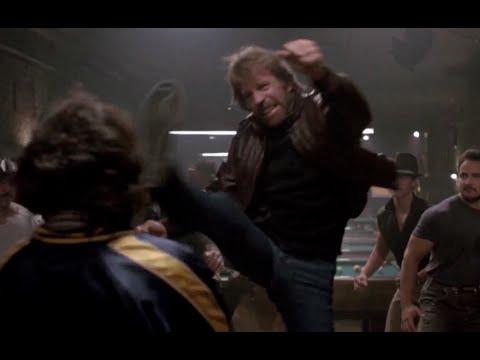
Mind you, none of Norris’s films are what’d you consider “great,” especially when compared to his Hong Kong contemporaries in the martial arts genre. Compared to the intricate and stylized choreography of Jackie Chan’s films from the same era (e.g., 1978’s Drunken Master, 1983’s Project A, 1985’s Police Story), Norris’s films can seem plain, even humdrum. He had nothing close to Chan’s agility or comedic chops.
Nevertheless, there’s something about those aforementioned films — a certain, ineffable Chuck Norris-ness, if you will — that makes even a portentous mess like 1985’s Invasion U.S.A. worth checking out. His best films, like The Octagon and Lone Wolf McQuade, work because they dip their toes into the murky waters of exploitation and grindhouse cinema — The Octagon features a secret ninja army, for example, while Lone Wolf McQuade is filled with sweat-stained desert violence — without plunging headlong into any truly explicit or gratuitous nastiness.
That probably explains why those films caught my attention on Omaha’s KPTM during my grade school and junior high years. They possessed a grittiness that was detectable even when I was a pre-teen, and set them apart from “normal” Hollywood fare. But even with all of the roundhouse kicks and bloody squibs, they were still relatively clean and morally uncomplicated. That aesthetic arguably achieved its purest form in Walker, Texas Ranger, which ran for nine seasons and 200+ episodes with Norris as the titular lead.
His films’ moral simplicity isn’t too surprising given Norris’s Christian beliefs and conservative politics. He didn’t just make films like Missing in Action, Invasion U.S.A., and 1986’s The Delta Force that are suffused with patriotic and pro-America themes. He also endorsed numerous Republican politicians, including Mike Huckabee, John McCain, Mitt Romney, and Donald Trump; penned patriotic books; and wrote columns for the far-right WorldNetDaily. He supported the Proposition 8 ban on gay marriage, dabbled in Barack Obama “birther” conspiracy theories, and even went so far as to suggest that an Obama victory in 2012 could result in America being “lost forever.”

Many have latched onto those aspects of Norris’s life when commenting on his death, with the result being mockery, celebration, and a dismissal of Norris as bigoted MAGA scum. (On a side note, I have little doubt that many of those same people criticized Trump for celebrating Robert Mueller’s death, but that’s a topic for a whole ‘nother post.) Such easy dismissal, however, is complicated by tributes from people who actually knew and worked with Norris.
Norris’s fellow action stars, including Arnold Schwarzenegger and Jean-Claude Van Damme, all shared their praise and condolences while Danica McKellar shared a warm memory from the set of Walker, Texas Ranger. But perhaps my favorite Norris tribute comes from film critic Drew McWeeny, who wrote about the time he got to introduce his dad to Norris. An outspoken liberal, McWeeny no doubt opposed every single one of Norris’s political stances. Even so, his reminiscence celebrates Norris’s generosity:
Chuck Norris was definitely not my hero. My dad is. But getting to introduce your hero’s hero to them is one of those strange pleasures that this job afforded me, and I will always love Chuck for being so good to the man who means everything to me.
I don’t expect any such tributes to change the minds of those who’ve already chosen to celebrate Chuck Norris’s death. Look no further than the comments on Rainn Wilson’s tribute to Norris for proof of that. (Sample comments include “He was a Trump activist who went against everything you claim to stand for” and “He was nice to you bc you’re white.”) But this event serves as yet another stark reminder that (1) human beings, including our political opponents, can be surprisingly complicated; (2) demonization is really tempting and all-too-easy, especially in the rarefied air of social media; and (3) we quickly forget those first two when politics becomes the only lens through which we see people, even martial arts superstars.