Richard Harrison (1936-2026)
When people think of martial arts cinema icons who’ve shuffled off this mortal coil, the first names that come to mind are probably Bruce Lee and Chuck Norris. Meanwhile, genre fans might mention Chang Cheh, Norman Chu, Cheng Pei-pei, Jimmy Wang Yu, Lau Kar-leung, Corey Yuen, and so on. Odds are, the recently deceased Richard Harrison — who died at the age of 90 earlier this month — probably won’t make such a list for most people, and understandably so.
Unlike Lee, Norris, et al., Harrison didn’t come from the world of martial arts. Rather, he got his start in body-building, which led to roles in Italian sword-and-sandal movies like 1961’s The Invincible Gladiator and 1963’s Medusa Against the Son of Hercules. He worked steadily in Europe throughout the ’60s and ’70s, and starred in everything from spy thrillers and war films to spaghetti westerns. (Fun fact: Harrison was the one who told Sergio Leone to hire a young unknown named Clint Eastwood for a little film called A Fistful of Dollars. Harrison would later joke that that was his biggest contribution to cinema.)
By the ’80s, though, Harrison had grown frustrated with the Italian film industry, and moved to Asia. There, perhaps unwittingly and much to his chagrin, he began his career as a Z-grade action movie icon. Working for the Silver Star Film Company in the Philippines, Harrison starred in stuff like Blood Debts, a riff on Death Wish that’s so disjointed, nonsensical, and poorly made that “low budget” doesn’t even begin to describe it.

However, it wasn’t until he arrived in Hong Kong and met director Godfrey Ho that Richard Harrison truly began carving out a unique niche in martial arts cinema — though he didn’t necessarily have a say in the matter.
I’ve written before about Ho’s (in)famous “cut and paste” approach to filmmaking. After shooting original footage with his own cast and crew, Ho would then splice it with footage from other films that his studio (IFD Films) owned the rights to, which allowed him to churn out lots of new films on the cheap. Needless to say, Ho’s films — many of which center around ninjas doing mystical ninja things — are coherent only in the loosest sense of the word, and yet that very quality imbues them with a bizarre-ness that some (including yours truly) find endlessly fascinating.
Harrison was one of Ho’s biggest stars, and appeared in such fantastically titled films as Ninja Terminator, Ninja the Protector, Golden Ninja Warrior, Ninja Operation: Licensed to Terminate, and Diamond Ninja Force. He typically played a secret ninja master who would just sort of amble through the film — thanks to Ho’s nonsensical editing — until the final act, where he’d then summon his mystical ninja powers to defeat the bad guy.
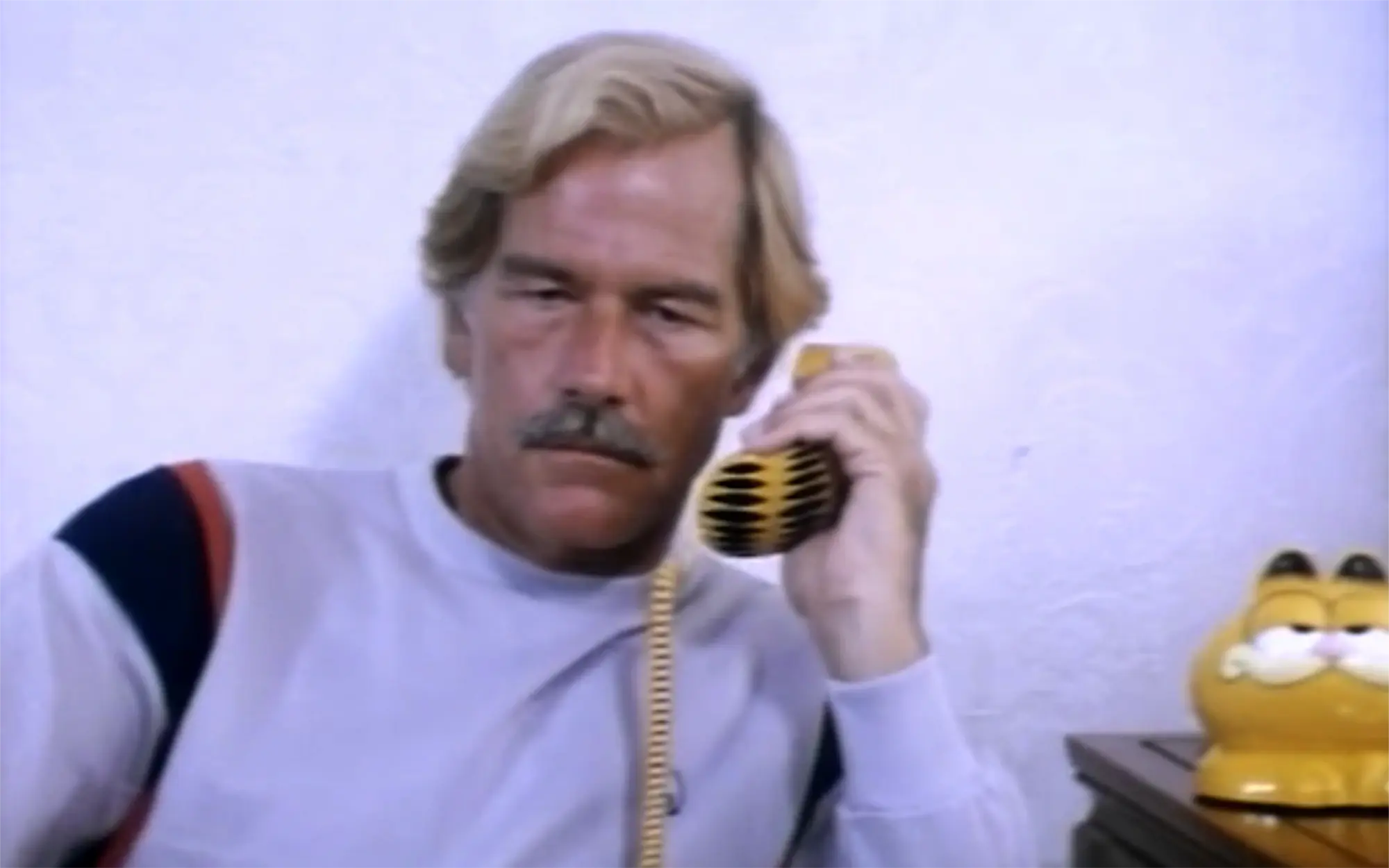
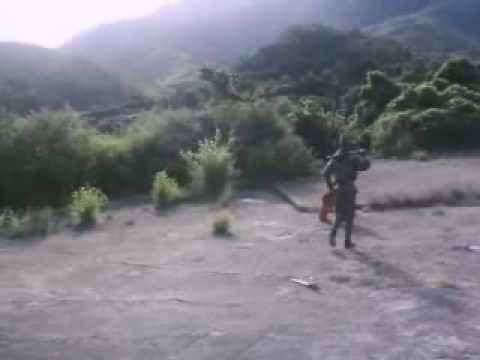
To Harrison’s credit, it’s clear, even with Ho’s slice n’ dice editing, that he was a professional doing his best, regardless of whether he was talking on a Garfield phone, receiving ninja threats from a toy robot, or wearing a bandana with the word “Ninja” emblazoned on it. Unfortunately, the films that Harrison is arguably best known for were a source of great embarrassment for him.

Speaking with Nanarland, Harrison revealed that he was essentially forced by producer Joseph Lai to keep working with Ho in order to pay off taxes resulting from a fraudulent contract. Furthermore, he had no idea at the time just how many films were being created with the footage he’d shot. Working with Ho and IFD left him feeling used and betrayed, and so Harrison returned to the States in 1986. (Not surprisingly, Ho kept using footage of Harrison for his films for several more years, as evidenced by 1988’s Ninja Strike Force and Ninja Powerforce.)
Harrison’s final films included Angel Eyes, a 1993 softcore thriller starring Erik Estrada (aka, Ponch from CHIPs), John Phillip Law, and former Penthouse Pet Monique Gabrielle, and 2000’s Jerks. In addition to acting, Harrison also directed several films, including 1980’s Challenge of the Tiger, which starred Bruce Le (one of the many imitators who capitalized on Bruce Lee’s death) and 1986’s Terror Force Commando, which he also co-wrote. (I have no interest in seeing Angel Eyes and Jerks, but you better believe I added Challenge of the Tiger to my Tubi queue.)
I don’t know that I can fully explain why I find Richard Harrison’s filmography so fascinating. I think it’s because Harrison, along with the other non-Asian actors who appeared in Godfrey Ho’s films (e.g., Kent Wills, Mike Abbott), represents a curious alternative to the more well-known martial arts worlds of Golden Harvest and Shaw Brothers.
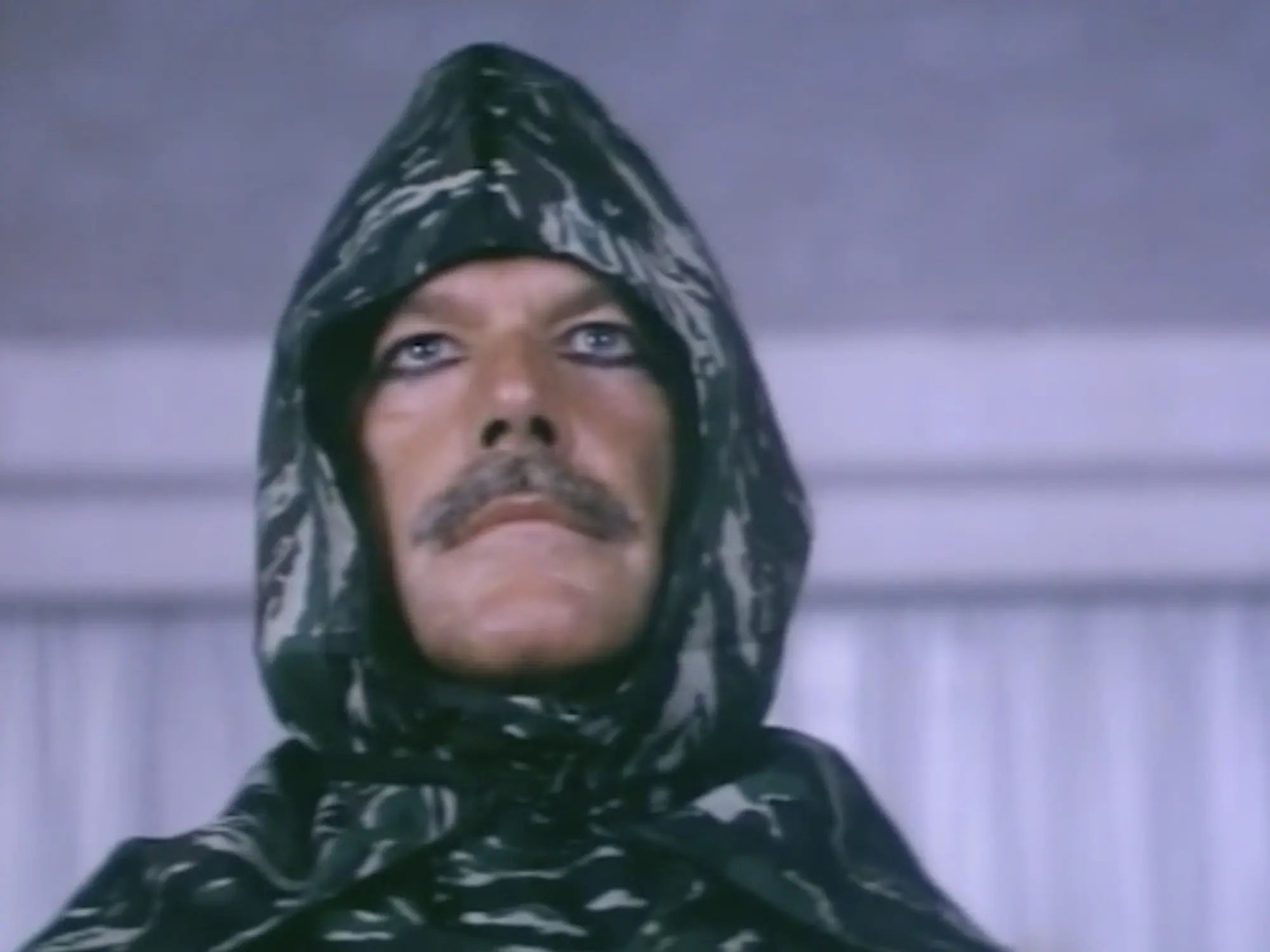
Obviously, no one would ever mistake Ninja Terminator and Diamond Ninja Force for good films, or Godfrey Ho for a good (or even ethical) filmmaker. And yet, those films are so bizarre that they seem like artifacts from a parallel dimension. And yet, for all of their considerable awfulness, I appreciate the glimpse they provide because it’s truly unlike anything else. They’re certainly not for everyone, but for fans of cult cinema, it really doesn’t get much cult-ier than Richard Harrison as a mustachioed and eyeliner-wearing ninja.
I certainly don’t want to downplay or dismiss Richard Harrison’s embarrassment and frustration at how his film career turned out thanks to his association with Godfrey Ho, Joseph Lai, and IFD Films. At the same time, though, there’s no denying that he was an instrumental part of a truly unique part of film history. As Mike Haberfelner wrote in his extensive Harrison biography, “it’s fair to say that [Harrison] wasn’t even too great an actor, but without him and his 100+ films output, the history of unusual, trashy and insane movies would be a whole lot poorer.”