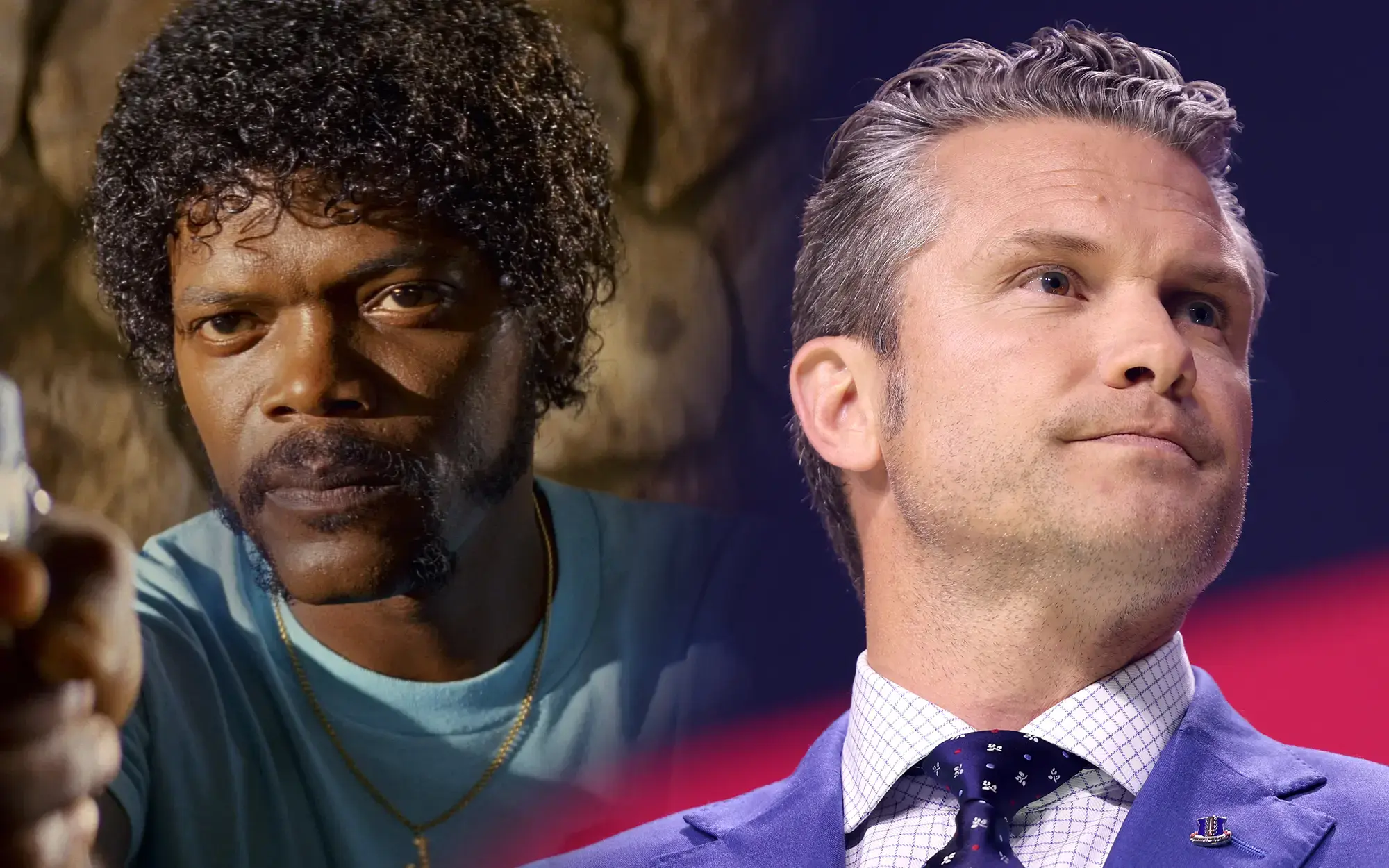
Quentin Tarantino’s Pulp Fiction is filled with scenes and dialog that are still memorable, even after more than 30 years. Jules and Vincent’s debate about the significance of foot massages. Christopher Walken’s watch monologue. Marsellus’s threat to “get medieval” on “Mr. Soon-To-Be-Living-The-Rest-Of-His-Short-Ass-Life-In-Agonizing-Pain Rapist.”
And then there’s Jules’s recitation of Ezekiel 25:17, which is delivered with all of the conviction of a fire and brimstone preacher before he and Vincent execute poor, hapless Brett.

The real Ezekiel 25:17 is nowhere near that long or verbose, but rather, simply reads “I will execute great vengeance on them with wrathful rebukes. Then they will know that I am the Lord, when I lay my vengeance upon them.” As part of a prophecy against the Philistines, it contains no mention of the righteous man’s path, the inequities of the selfish, or the tyranny of evil men. And there’s certainly nothing in there about being a shepherd or the finder of lost children.
The fact that it’s a fictional Bible passage didn’t stop Defense Secretary Pete Hegseth, however, from using a variation of Pulp Fiction’s Ezekiel 25:17 to lead the audience in prayer during a recent service at the Pentagon. Claiming that it was a prayer called “CSAR 25:17” that’s recited by Combat Search and Rescue (CSAR) teams like the one that rescued the downed airman in Iran earlier this month, Hegseth prayed:
The path of the downed aviator is beset on all sides by the inequities of the selfish and the tyranny of evil men. Blessed is he who in the name of camaraderie and duty shepherds the lost through the valley of darkness, for he is truly his brother’s keeper and the finder of lost children. And I will strike down upon thee with great vengeance and furious anger those who attempt to capture and destroy my brother, and you will know my call sign is Sandy One when I lay my vengeance upon thee. Amen.
Is this “prayer” really recited by CSAR teams as Hegseth claims? It certainly seems plausible, the sort of thing that soldiers might recite to psych themselves up before going on a dangerous mission. But as Andrew Thayer writes, there’s also something dangerous about using Scripture in the context of military violence, and especially made up Scripture like Pulp Fiction’s Ezekiel 25:17:
First, it falsely presents fabricated movie dialogue as scripture, blurring the distinction between revelation and entertainment. Second, it shifts language spoken by God in the Bible into the mouth of human military actors, subtly granting divine authority to state violence. Third, because the borrowed language comes from films built around vigilante revenge fantasies, it imports into military prayer the moral psychology of righteous vengeance rather than the tragic restraint that should accompany any use of force.
Prayer in a military context is never merely decorative, it shapes imagination. When the language of prayer teaches soldiers and leaders to hear themselves in the voice of divine vengeance — especially through words borrowed from cinematic executions — it risks sanctifying violence by wrapping it in sacred prestige. The danger is not that a movie quote slipped into a ceremony. The danger is that the state begins to speak of lethal power in the idiom of mythic revenge, and mistakes that idiom for holiness.
On a side note, Thayer gets some bonus film nerd cred for pointing out that Pulp Fiction’s Ezekiel 25:17 was, in fact, inspired by the opening speech from 1973’s The Bodyguard, starring Japanese martial arts legend Sonny Chiba. (Tarantino’s admiration of Chiba is no secret; he cast the actor in the Kill Bill movies as Hattori Hanzō, the legendary swordsmith who forges the katana that Uma Thurman’s character wields on her quest for revenge.)
In addition to the points that Thayer makes, Hegseth’s use of the passage — which, again, he doesn’t just share as an anecdote but actually prays, and asks others to pray along with him — also serves as yet another sterling example of the lack of cultural hermeneutics that so pervades Trumpian circles.
If you’ve seen Pulp Fiction, then you know that Jules recites Ezekiel 25:17 twice. The first time occurs early in the film, when he and Vincent pay their deadly visit to Brett and his friends. The second time occurs at the film’s end as Jules and Vincent eat some breakfast and reflect on the day’s strange events, and in particular, the moment when Brett’s roommate jumped out, unloaded a gun at them point black… and somehow missed.
Jules is convinced that was a miracle. “I felt the touch of God,” he tells an incredulous Vincent, who dismisses it as just a freak occurrence. While Jules is contemplating his miracle and its significance for his life, though, two would-be thieves decide to rob the restaurant. Being a hardened hitman, Jules quickly turns the tables on them, and holds one of them at gunpoint. Then, in one of my all-time favorite movie scenes, he recites Ezekiel 25:17, only now from a very different perspective.

Ezekiel 25:17 used to be “some cold-blooded shit” that Jules would say before killing someone, a little sermon he would preach to justify his violence as the work of a righteous man. But after experiencing the touch of God — or perhaps more accurately, the inexplicable grace of God that would spare even a violent man such as himself — that same passage now convicts Jules and forces him to realize the truth: that far from being righteous, he’s actually “the tyranny of evil men” who preys upon the weak. And now, he desires nothing more than to lay down his gun and become a man of peace — to become the shepherd.
Ultimately, Pulp Fiction’s Ezekiel 25:17 is not a call to “strike down… with great vengeance and furious anger.” Rather, Jules — and the attentive viewer — realizes that it’s a call to walk away from violence, to embrace peace, and to even extend grace to one’s enemies. We never learn what ultimately happens to Jules. Presumably, he’s still out there walking the Earth, like Caine in Kung Fu. As for Vincent, who chooses to deny the miracle and remain in Marsellus Wallace’s employment, he receives a bloody end.
Jules is not the only character in Pulp Fiction to face a moment of moral crisis. Butch the boxer, for example, is forced to ask himself whether he’ll go back and rescue Marsellus Wallace, the man who’s hellbent on killing him, from a group of sadists. For all of its violence and foul language, Pulp Fiction’s overarching theme — regardless of whether Quentin Tarantino intended it or not — seems to be a warning against those like Vincent who choose to embrace violence instead of grace.
Given his macho posturing and love of violent rhetoric, it’s not surprising that Pete Hegseth missed that entirely, and chose instead to glory in the empty, blood-soaked vengeance that Jules Winnfield walked away from.