The Gift of Tears/Mirror/Paradis EP by Revolutionary Army of the Infant Jesus (Review)
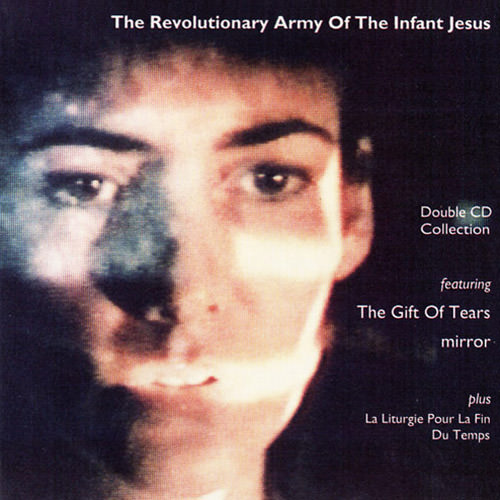
C.S. Lewis once wrote “Holy places are dark places.” If his sentiment could be expressed physically, it would undoubtedly find embodiment in the music of the Revolutionary Army of the Infant Jesus. These English musicians appear well-versed in the western liturgical music tradition which seems to be the basis of their beautifully reverent and dark compositions. In addition to simple chant-like vocals sometimes haunted with an ethereal, childlike female voice, RAIJ incorporates such an array of musical elements it’s impossible to name them all. They combine folk, Celtic, world beat, tribal percussion, Eastern European, and some Middle Eastern influences into a truly original sound.
RAIJ’s first album, The Gift of Tears, explores some of these components in notable pieces such as “Come Holy Spirit” and “Beauty after the Fall.” The first one begins with a lone classical guitar, soon accompanied by bass and tribal percussion while a simple, chant-like melody and a floating female vocal carry the piece. “Beauty” is just that, a harmony of classical guitar, woodwind melody, and spoken word.
The Gift of Tears is very much organic and acoustic, but there is also quite a bit of experimentation in all of RAIJ’s music. You’ll hear the clanging of cathedral bells, echoing percussion, and spoken word in foreign languages, including samples from the films of Andrei Tarkovsky and Jean Cocteau. “De Profundis” is full of reverberating metallic clanks, layers of feedback, and a swirl of wind instruments.
Overall, the second album, Mirror, is more experimental than the first. Although there is less use of acoustic instruments, the earthy element is still present but is saturated with processed sounds and samples. “Nostalgia” is a beautifully somber and captivating piece composed of a dark orchestral arrangement and a piano interlude while a man’s voice drones in the background. Another composition meshing samples and noise with instruments is “Psalm.” Unidentifiable whooshes and echoes soar across the clear solemnity of a child-like voice singing the words of Psalm 51.
In the new EP Paradis, RAIJ continues to blend organic instruments and experimental sounds into lush masterpieces. “The Parable (of the Singing Ringing Tree)” is an 8-minute rendering of the original found on The Gift of Tears, this time made fuller with an accordion-like instrument and guitar. “Mouvement” is a simple but well-crafted piece consisting only of congas. The focus of “Paradis” is the ethereal female voice which swoops and echoes with a semi-operatic quality. Perhaps the highlight of the EP is “She Moved Through the Fair,” an atmospheric piece slowly building in percussive speed and intensity reminiscent of the final movement of Ravel’s “Bolero.”
What’s fascinating about RAIJ is their ability to marry a diversity of musical elements into cohesive compositions. You would assume that feedback and electronic samples would mar the traditional elegance of chant and western folk instruments, but they collide and then fuse into the fullness of sound this group creates. RAIJ transports the listener into an otherworldly cathedral in which mechanical cacophony unites with organic melody to produce sound both beautiful and somber.
Written by Cathy Nieng. This review originally appeared on the Flaming Fish Music website.