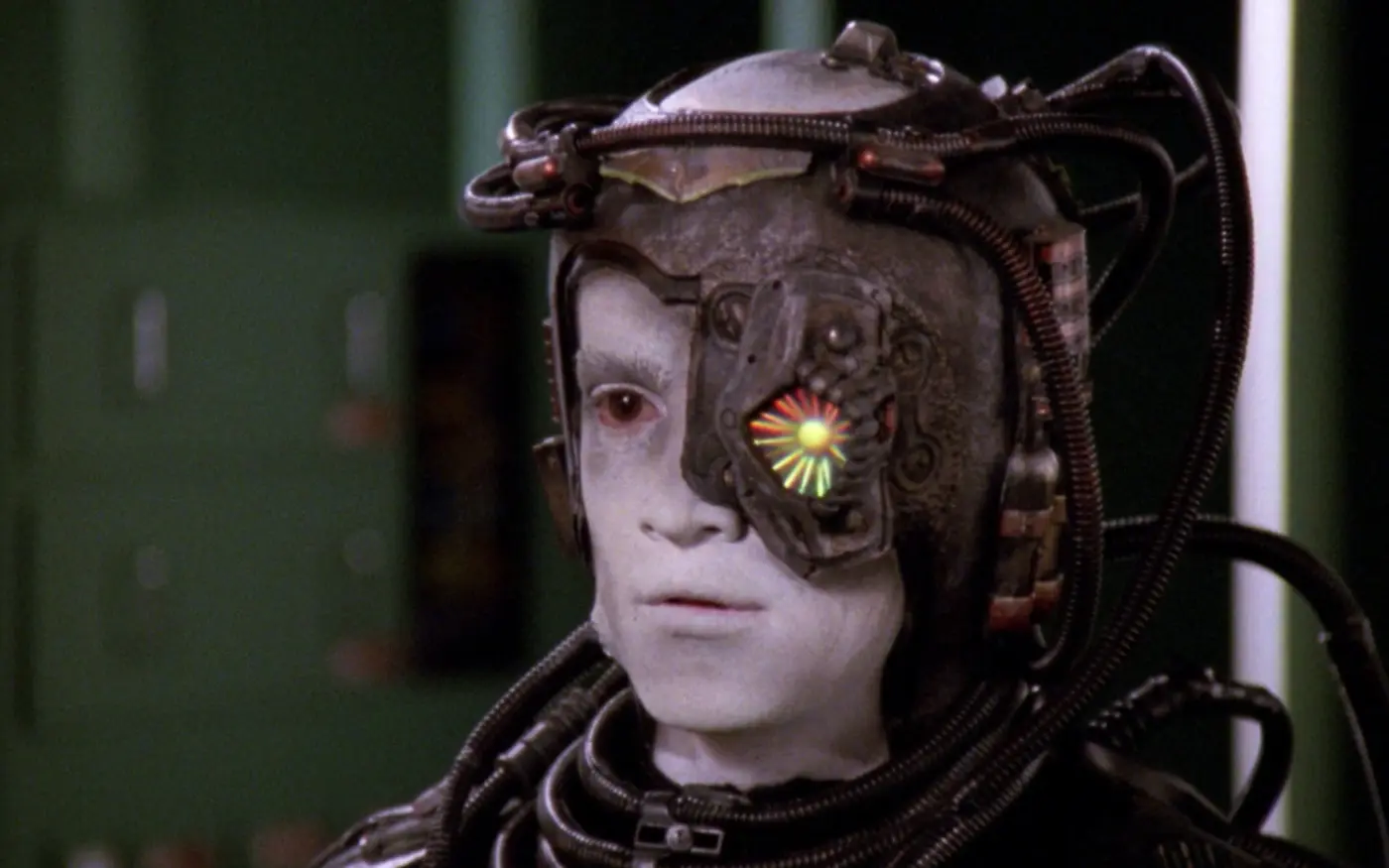
After the one-two punch of “The Best of Both Worlds” in seasons three and four, the producers of Star Trek: The Next Generation had a problem: They had done too good a job of making the Borg a terrifying, galactic-level menace and didn’t really know what to do with the cybernetic collective. At the same time, they couldn’t just forget about the Borg; as an existential threat to the values of the Federation, they were simply too good of an enemy. So screenwriter René Echevarria did the only obvious thing: he made the Borg the good guys.
Or at least one of them.
The following contains spoilers for “I, Borg.”
The Enterprise is exploring an uncharted star system when they detect a possible distress call. They discover a crash site, and to their dismay, it’s a Borg scout ship. Fearing detection, Picard’s first inclination is to flee the scene, except one of the Borg crew has survived. Crusher, being the good doctor that she is, insists on beaming the Borg up to the Enterprise so she can treat it, and surprisingly, Picard agrees.
As the Borg is being treated/repaired, Picard asks La Forge if he can modify some of its cybernetic implants to introduce a virus that will strike at the root commands used by all Borg, thus affecting the entire Collective. Working with Data, La Forge comes up with a clever solution: a seemingly innocuous geometric image that, when processed by the Borg’s implants, will create an invasive program that slowly spreads and cripples the rest of the Collective.

Crusher is horrified by this plan, and compares it to genocide. What follows is one of those classic Star Trek moral debates, except this time, it’s the usually noble Picard who seems to be taking the low road, insisting that the Borg have forced the Federation into an impossible situation and they have no other choice.
The good doctor isn’t the only one with reservations, though. La Forge’s initial interactions with the Borg, which calls itself “Third of Five,” are chilly at best as it continually insists, as Borg are wont to do, that the Enterprise will be assimilated and resistance is futile. But as La Forge spends more time with Third of Five — now named Hugh — the Borg no longer seems like a mindless automaton. Indeed, as La Forge and Hugh interact, Hugh begins to question the Collective’s drive to assimilate, and even goes so far as to suggest that he and La Forge are now friends.

La Forge expresses his growing doubts to Picard but the captain is unmoved, and coldly suggests that La Forge “unattach” himself from the Borg in order to complete the mission. But Picard’s resolve finally starts to waver when none other than Guinan voices her own reservations.
Earlier in the episode, Guinan, whose race was all but exterminated by the Borg, visits Hugh and disdainfully mocks him. But when he finds some similarities between their situations — both of them, having been cut off from their respective peoples, are lonely — Guinan is left speechless. She heads to Picard’s quarters, where she tells Picard that if he’s hellbent on using Hugh to destroy the Borg, then he ought to have the decency to look Hugh in the face first.


And so Picard has Hugh beamed to his ready room, where Hugh recognizes him as Locutus, the Borg identity forced upon Picard in “The Best of Both Worlds.” Picard begins interrogating Hugh as Locutus, insisting that the Enterprise will be assimilated. Hugh pushes back, claiming that the Enterprise, including his new friend Geordi, would rather die than become Borg. Picard doubles down and orders Hugh to help with the assimilation, only to be taken aback when Hugh refuses to comply, and even more shockingly, refers to himself in the singular.

And that’s that. Hugh, La Forge, and the rest of the Enterprise live happily ever after together. Of course, that’s not what really happens. And to be honest, it’d make for a bad episode if it did. Instead, “I, Borg” wisely decides to pile on the complications.
In light of Hugh’s development, Picard decides to change the plan. Rather than using him to infect the Borg with a virus, they’ll send Hugh back as is, in the hope that his newfound sense of individuality will be what infects the Collective and brings them down. That sounds far more humane and civilized, until Crusher points out a fatal flaw in this new plan: What if Hugh doesn’t want to go back to the Collective?
Picard decides to let Hugh choose his fate, and grants the former Borg an offer of amnesty. Hugh is initially excited by the prospect, but ultimately declines Picard’s offer. If the Borg know he’s still alive, they’ll never stop looking for him, which would place the Enterprise in danger. Hugh therefore decides to return to the crash site and await retrieval. La Forge beams down with Hugh, and the two share a brief farewell before the Borg arrive and re-assimilate him.
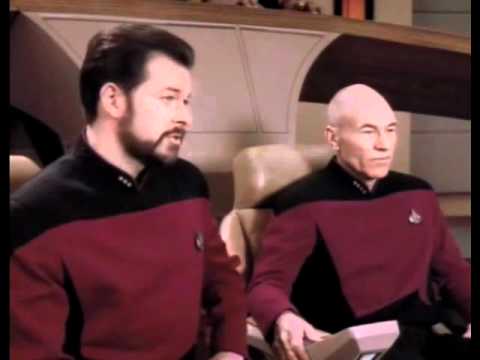
Hugh seems to be a mindless drone once more. But in the episode’s final scene, he shares a brief-but-meaningful look with La Forge just as he’s beamed away, leaving La Forge alone to ponder the events.
“I, Borg” could have easily been a preachy, “tell, don’t show” episode that beats you over the head with the point it’s trying to make. And indeed, the dialog, be it the crew’s debate about genocide or Hugh’s growing individuality, is pretty on-the-nose throughout the episode. But “I, Borg” is ultimately a testament to The Next Generation’s cast. Everyone with prominent screen-time — namely, Patrick Stewart, LeVar Burton, Gates McFadden, Whoopi Goldberg, and Jonathan Del Arco, who played Hugh — is at the top of their game here.
Stewart makes Picard’s sense of violation at the hands of the Borg a plausible explanation as to why the redoubtable captain might be amenable to genocide and war crimes. Burton ably reveals LaForge’s growing uncertainty and sense of guilt. McFadden’s compassionate Crusher stands out as the lone voice of reason and morality. Goldberg pulls off Guinan’s own moral journey, which starts off aligned with Picard in accusing the Borg before transitioning into doubt after realizing that she might have something in common with her worst enemy. But perhaps the greatest kudos go to Del Arco, who plays Hugh with a sense of childlike innocence and naïveté that proves quite affecting even under all of the makeup and prosthetics.
Some other thoughts and observations from “I, Borg”:
- What was going through the minds of the security personnel as they watched La Forge, Crusher, et al., interact with Hugh? If I’d been one of them, I might begin to worry that the bridge crew was getting a little too chummy with one of the Federation’s worst enemies, and wonder if I should report it or not.
- On a related note, why was Guinan — a civilian — allowed to talk to a prisoner in the brig? Does she basically have free rein of the Enterprise on account of her friendship with Picard? Or did she use her charms to talk her way into the brig?
- I understand why the script would have Hugh decide to leave the Enterprise and return to the Borg; as a sacrificial act, it represents the culmination of his growth as a moral individual, and it stands in stark contrast to Picard’s own behavior. But would the Borg, who are obsessed with efficiency, really have expended the resources necessary to track down and reclaim one single drone? That seems rather un-Borg-like. (This is the same species, after all, that tends to ignore boarding parties on their own ships.)
- In order to escape detection from the Borg vessel that’s coming to reclaim Hugh, the Enterprise hides in the nearby star’s chromosphere. Picard reveals this plan to Hugh in the transporter room just before he beams down to be reclaimed by the Borg — who would presumably learn Picard’s plan upon re-assimilating Hugh. Which honestly seems like a bit of a tactical error.
- Picard has some great moments in this episode as the ostensible villain. (Because, y’know, he’s asking his crew to commit genocide.) But one of my favorite moments occurs in the aforementioned transporter room when Hugh says that he doesn’t want to forget who he’s become. Picard gives him a slight smile, and then, after Hugh is gone, reveals a much more conflicted expression. I imagine that’s the sort of expression a Starfleet captain has after he’s knowingly sent crew members to their doom.
- As I mentioned before, Del Arco’s performance as Hugh serves as the episode’s heart and soul. And all the more so once you know his performance was inspired by his partner, who died from AIDS shortly before Del Arco’s audition. From a 2020 interview: “I opened the script and I heard his voice. As it turns out, the voice was the voice of my previous partner who had died of AIDS and had dementia. I don’t know why, but that was the voice I heard. It was the innocence. It was the wonder.”
- One of the episode’s most impactful moments occurs when Hugh announces “I am Hugh” to a stunned Picard, revealing his newfound individualism. However, Hugh actually refers to himself in the singular earlier in the episode, when he receives his new name. Unfortunately, by the time Echevarria realized that error in his script, the scene had already been shot.
- “I, Borg” is one of the few TNG episodes that has repercussions later in the series. (One other such episode is “Yesterday’s Enterprise” from season three.) Hugh returned in the two-part episode “Descent” in seasons six and seven, where he led a group of Borg rebelling against Data’s brother Lore, who was attempting to take over the Borg Collective. He also appeared in Star Trek: Picard’s first season as an advocate and caretaker of “xBs,” individuals who were former members of the Borg Collective.
“I, Borg” was the 23rd episode of The Next Generation’s fifth season. The show was operating like a warp drive at peak efficiency by then, and that season contains several classic TNG episodes, including “Darmok,” “Disaster,” the “Unification” two-parter with Spock, “Cause and Effect,” “The Next Phase,” and “The Inner Light” (widely considered one of all-time best TNG episodes, if not the best). “I, Borg” easily ranks up there among them, adding some nuance to the series’ biggest, baddest villain while also interrogating our beloved characters, and revealing that even the noblest and most enlightened Starfleet officer is still capable of bigotry and prejudice.