I’m a sucker for those Star Trek episodes in which our intrepid explorers square off against godlike entities, matching their wits against yet another alien omnipotence. The Star Trek universe contains many of these entities, with the most famous being Q, who wrought havoc throughout the galaxy in episodes like The Next Generation’s “Encounter at Farpoint” and Voyager’s “Death Wish.”
Be it Q, Trelane, or V’ger, these entities occupy an interesting spot within Star Trek’s officially secular universe. Even Star Trek, it seems, has a “God-shaped hole,” and such entities are used to explore the conflict between faith and science, examine weighty philosophical themes, test our beloved characters’ mettle (and by extension, all of humanity), and see how well Starfleet’s utopian humanism fares against the universe’s indifference.
Which brings us to Nagilum from season two’s “Where Silence Has Lease.” Arguably the most enigmatic and disturbing “god” in the Star Trek universe, this strange entity is a fine representation of the cosmicism expressed in Stephen Crane’s famous poem, “A Man Said to the Universe.”
The following contains spoilers for “Where Silence Has Lease.”
The Enterprise-D is charting the unexplored Morgana Quadrant when they encounter a curious phenomenon: a “hole” in space that’s devoid of all matter, energy, and dimension. By all rights, the hole doesn’t exist, and yet it’s right there in front of them.
As the Enterprise performs a routine survey of this curious phenomenon, the hole suddenly expands, engulfing the ship. Despite their best efforts, Captain Picard et al. are at a complete loss to explain their bizarre new location. No matter how far they peer into its expanse, it looks the same. No matter how far they travel at warp speed, they end up right back where they started.
After destroying a surprise Romulan Warbird that, strangely, leaves no trace of its destruction, the Enterprise is met by their sister ship, the U.S.S. Yamato — despite the Yamato being nowhere near the Morgana Quadrant. Riker and Worf beam over in hopes of learning something about the void, only to encounter more strangeness.
For starters, the Yamato is composed of alien materials that surpass Starfleet technology. Even stranger, the Yamato’s bridge isn’t where it’s supposed to be and appears to be a spatial anomaly that loops on itself. At one point, Worf looks through one of the bridge’s doors and sees another bridge with another Riker. Or is it the same bridge and Riker seen from a different point in space?
While Riker and Worf are aboard the Yamato, an opening back to normal space appears before the Enterprise, only to close before the away team can be beamed back. And then the Yamato itself begins to fade away, disappearing only moments after a frazzled Riker and Worf are safely transported back to the Enterprise. More openings to normal space appear, each one disappearing before the Enterprise can even move in its direction.
Counselor Troi — who previously sensed nothing amiss — now admits to feeling a mysterious alien presence so vast it previously eluded her. Dr. Pulaski notes that they’re being treated like rats in a science experiment; someone or something is testing their responses to stimuli. Another star-filled opening to normal space then appears, but this time, Picard refuses to acknowledge it.
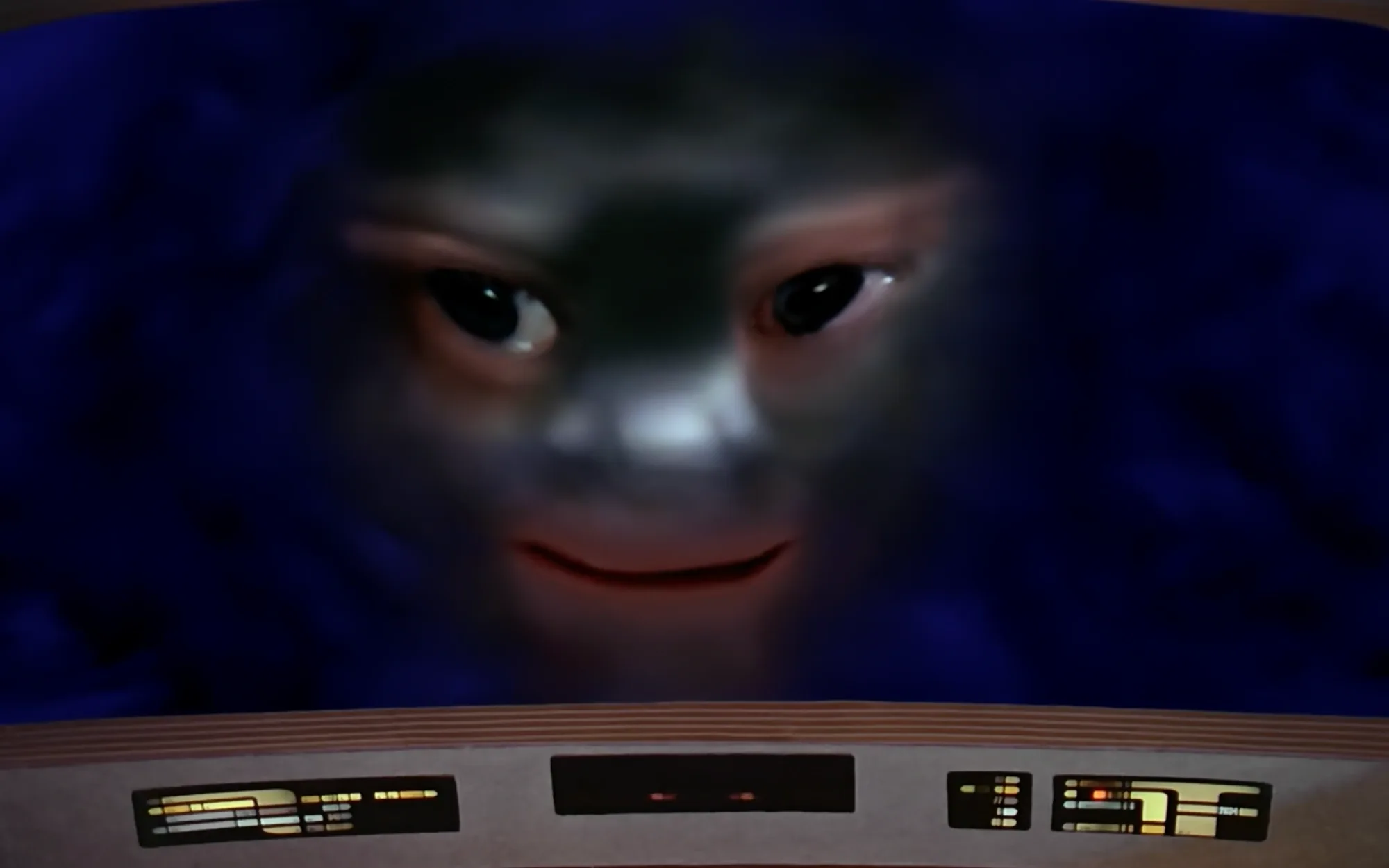
Which is when Nagilum finally reveals itself as a bizarre, infant-like face floating in the void.
Nagilum gives the bridge crew a once-over, noting the differences in their construction (i.e., gender) and expressing a specific interest in their “limited existence.” At which point, helmsman Ensign Haskell begins convulsing violently and drops to the bridge floor where he dies in agony. (Not surprisingly, Haskell’s wearing a red uniform.) After observing Haskell’s death with great interest, Nagilum calmly explains that in order to fully understand death, it must learn everything there is to know about dying — which will require killing “only” a third of the Enterprise’s crew, maybe half.
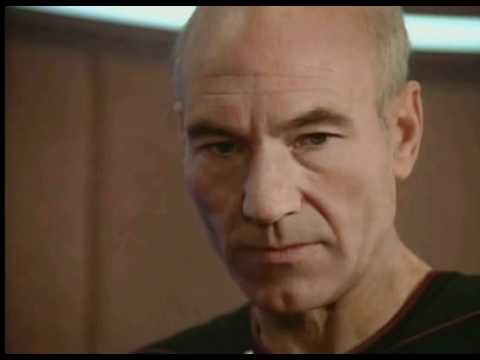
Picard refuses to accept Nagilum’s plan. It’s clear, however, that they can’t escape Nagilum, nor can they possibly hope to fight it. But rather than submit to Nagilum and allow it to randomly murder his crew, Picard opts to destroy the Enterprise instead. This leads to a grimly humorous moment as Picard and Riker discuss how long to set the auto-destruct timer. Is it better to end things quickly or give the crew time to prepare for death? They eventually settle on twenty minutes — a “nice, round figure” — and start the countdown.

Shortly afterwards, Picard is resting in his quarters when Troi and Data come by for a visit. Data, the ever-inquisitive android, wants to know what death is, which a bemused Picard attempts to explain. Meanwhile, Troi argues that it’s wrong for Picard to force the entire crew to die. She would much rather take her chances on being one of the survivors, as would Data.
Is Picard overreacting to Nagilum’s threat? Destroying the Enterprise might make sense in a combat situation to prevent Starfleet intel and technology from falling into enemy hands. But in a non-combat situation, should Picard be so quick to doom the entire crew? Is suicide preferable to watching indiscriminate slaughter? Any such moral quandaries are forgotten, however, when Troi and Data mess up and call Picard “Jean-Luc,” making it clear they’re just projections of Nagilum intended to trip Picard up.
Our redoubtable captain rebuffs the alien entity yet again and suddenly, the Enterprise is back amongst the stars; Nagilum’s void is nowhere to be seen. Picard remains skeptical, however, and with one minute remaining, orders Crusher to take the Enterprise into warp speed on any heading. As the last minute counts down and the stars streak past the viewscreen, Picard refuses to cancel the countdown, much to his crew’s growing consternation. Finally, with mere seconds to spare, Picard cancels the auto-destruct sequence, with Riker concurring wholeheartedly.

In the episode’s coda, Picard is reflecting in his ready room when Nagilum appears on his computer display. The two have a testy exchange during which the entity critiques humanity’s nature, including its aggression and hostility. (Which seems more than a little ironic, all things considered.)
Picard responds that they both share the trait of curiosity — to which Nagilum agrees — and notes that they might meet again, but next time, it’ll be among the stars. Picard then returns to the bridge and orders Crusher to resume their original course, with Riker adding “if you encounter any holes, steer clear.”
Some additional thoughts concerning “Where Silence Has Lease”:
- The episode was written by Jack B. Sowards, who also wrote Star Trek II: The Wrath of Khan — arguably the best Star Trek movie — as well as episodes of Barnaby Jones, T.J. Hooker, and B.L. Stryker.
- The episode begins with Riker joining Worf on one of his calisthenic routines, i.e., stalking around the holodeck and battling monsters. Worf gets a little too caught up in the bloodlust, though, and nearly takes out Riker, a nice foreshadowing of the Klingon’s instability when he experiences the Yamato’s strangeness. I’m guessing Riker opted out of any more Klingon calisthenics after this, choosing instead to focus on his anbo-jyutsu skills.
- Pulaski really doesn’t do herself any favors in this episode, referring to Data as “it” and a “non-living device.” It’s almost like the show wanted fans to hate her character. (Fortunately, Dr. Crusher returned the following season.)
- Nagilum doesn’t appear until the episode’s final third, making “Where Silence Has Lease” a nicely enigmatic slow burn. In addition to those episodes about godlike entities, I’m also a fan of Star Trek episodes that take their time unraveling some central mystery (e.g., “Clues,” “Night Terrors,” “Cause and Effect”).
- Nagilum was voiced by Earl Boen, best known as psychologist Dr. Silberman who keeps getting traumatized in the Terminator movies. Boen, who died in 2023, had nearly 300 acting credits to his name, including M*A*S*H, Airplane II: The Sequel, A Pup Named Scooby-Doo, and The West Wing.
- The music that Picard’s listening to in his quarters is Erik Satie’s “Gymnopédie No. 1,” a lovely piece of music that would be a very fitting soundtrack to contemplating one’s impending mortality.
- When Picard attempts to explain death to Data, he highlights two competing views (a very generic “religious” one and a very generic “atheist” one) before offering his own: the “marvelous complexity of the universe” leads him to conclude that “what we are goes beyond Euclidean or other practical measuring systems, and that our existence is part of a reality beyond what we understand now as reality.” Which, in its essence, isn’t all too dissimilar from a “religious” viewpoint, but has just enough New Age-isms to avoid being too orthodox.
- Speaking of Data and death, one would think that an android with a storage capacity of 100 petabytes — which could easily contain every book ever written — would already be very familiar with the many perspectives on death. At least, he was in “The Next Phase” while planning La Forge and Ro Laren’s funeral. That ignorance should have clued Picard into the fact that something wasn’t right. Of course, Picard might’ve been too overwhelmed with thoughts of his own mortality to pick up on that.
- When Riker tells Crusher to avoid any other space holes at the episode’s end, he does so with a classic Riker smile as a triumphant Star Trek theme begins to swell. Given everything the Enterprise just experienced, methinks Riker should’ve delivered his line with a bit more foreboding and the ending music should’ve been a bit more ominous. (Consider, for example, the disquieting note on which season six’s “Schisms” ends.)
- Just how packed was Troi’s schedule after this episode?! I can only imagine how many people onboard the Enterprise needed to process both the encounter with Nagilum and nearly dying as a result of their captain’s decision. And I’m not just talking about the Enterprise crew, either, but their families, as well. True, any decent Starfleet officer would have weighed the risks before bringing their kids onto a Galaxy-class starship. Still, I’m sure Troi was booked solid for a few weeks at least.
- To that point, has there been a TNG episode in which Troi must counsel a traumatized Enterprise crew member? She counsels a traumatized child in “Hero Worship” and helps Worf with some parenting issues in “New Ground,” but that’s not exactly the same thing. (And no, Barclay doesn’t count.) Given the number of godlike beings who enjoy putting humanity to the test, one hopes that Starfleet Academy offers a few courses on how to help people make sense of such encounters.
- I was really impressed with the filmmaking in this episode. The camera makes great use of the Enterprise bridge’s limited space to heighten the tension and the characters’ emotional tenor. Meanwhile, the lighting and production design make the Yamato scenes appropriately eerie; rarely has late ’80s beige seemed so frightening.
Despite looking like a weird mutant space baby, Nagilum frequently appears in discussions of Star Trek’s scariest aliens, due to its impassive treatment of the Enterprise crew as well as its apparently limitless and inexplicable powers. I’m sure that on some message board or discussion forum somewhere, nerds have debated who’s more powerful, Q or Nagilum. Therefore, I won’t torture you with any such debate here.
For all of his malevolent machinations and protestations about humanity’s insignificance, though, Q proved more complex than some mere cosmic villain, even developing a heartfelt respect for Picard. Such is not the case with Nagilum. Even if it shares a sense of curiosity with humanity, I suspect that any future encounters with Nagilum would prove just as fraught as the Enterprise-D’s encounter.
That said, if future Star Trek titles do think it necessary to bring back a classic TNG villain, Nagilum wouldn’t get my vote. Some mysteries are best left mysterious; some gods are best left inscrutable and unknowable. I’d rather see Starfleet square off against the parasites from “Conspiracy” (who, if you’ll recall, sent a mysterious signal towards some unexplored part of the galaxy) or the subspace aliens from the aforementioned “Schisms” (who seemed a little more malicious than simple explorers). ’Tis probably best to leave Nagilum alone and unbothered in its void.